

Anti-C1QA Polyclonal Antibody
- Catalog number: PA10222
- Availability: In Stock
$168.00
- Ex Tax: $168.00
- Description: Anti-C1QA Polyclonal Antibody (PA10222) is a rabbit polyclonal antibody detecting C1QA in ELISA, IHC, WB. Suitable for Human.
Highlights:
• Affinity Purified — Minimal background and high purity for reliable results.
• Multi-Application — Validated across multiple applications. - Host species: Rabbit
- Species reactivity: Human
- Immunogen: E. coli - derived recombinant Human C1QA (Ala28-Ala245).
- Form: Liquid
- Storage buffer: 0.01M PBS, pH 7.4, 50% Glycerol, 0.05% Proclin 300.
- Clonality: Polyclonal
- Isotype: IgG
- Applications: ELISA, IHC, WB
- Target: C1QA,Complement C1q subcomponent subunit A
- Purification: Purified by antigen affinity column.
- Stability and Storage: Use a manual defrost freezer and avoid repeated freeze thaw cycles. Store at 2 to 8°C for frequent use. Store at -20 to -80°C for twelve months from the date of receipt.
- Background: Complement C1q subcomponent subunit A (C1QA) is a ~26 kDa protein. Core component of the complement C1 complex, a multiprotein complex that initiates the classical pathway of the complement system, a cascade of proteins that leads to phagocytosis and breakdown of pathogens and signaling that strengthens the adaptive immune system. The classical complement pathway is initiated by the C1Q subcomplex of the C1 complex, which specifically binds IgG or IgM immunoglobulins complexed with antigens, forming antigen-antibody complexes on the surface of pathogens: C1QA, together with C1QB and C1QC, specifically recognizes and binds the Fc regions of IgG or IgM via its C1q domain. Immunoglobulin-binding activates the proenzyme C1R, which cleaves C1S, initiating the proteolytic cascade of the complement system. The C1Q subcomplex is activated by a hexamer of IgG complexed with antigens, while it is activated by a pentameric IgM. The C1Q subcomplex also recognizes and binds phosphatidylserine exposed on the surface of cells undergoing programmed cell death, possibly promoting activation of the complement system.
References:
1. Kishore, U. et al. (2003) Journal of immunology (Baltimore, Md. : 1950) 171, 812-20. PMID: 12847249
2. Gadjeva, MG. et al. (2008) Biochemistry 47, 13093-102. PMID: 19006321
3. Diebolder, CA. et al. (2014) Science (New York, N.Y.) 343, 1260-3. PMID: 2462693
4. Ugurlar, D. et al. (2018) Science (New York, N.Y.) 359, 794-797. PMID: 29449492
5. Duncan, AR. et al. (1988) Nature 332, 738-40. PMID: 3258649
6. Zwarthoff, SA. et al. (2021) Proceedings of the National Academy of Sciences of the United States of America 118. PMID: 34155115
7. Lin, TY. et al. (1980) The Journal of biological chemistry 255, 7756-62. PMID: 6249812
8. Burton, DR. et al. (1980) Nature 288, 338-44. PMID: 6776418 - Note: For research use only.
Images
-
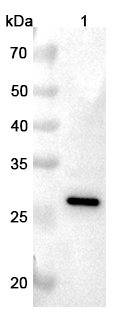 Western blot
Western blot analysis was performed using anti-CA1QA polyclonal antibody at 1μg/ml on various samples.
Lane 1: Human plasma lysate
Datasheet