
Anti-S100A9 Polyclonal Antibody
- Catalog number: PA10296
- Availability: In Stock
$168.00
- Ex Tax: $168.00
- Description: Anti-S100A9 Polyclonal Antibody (PA10296) is a rabbit polyclonal antibody detecting S100A9 in ELISA, IHC, WB. Suitable for Human.
Highlights:
• Affinity Purified — Minimal background and high purity for reliable results.
• Multi-Application — Validated across multiple applications. - Host species: Rabbit
- Species reactivity: Human
- Immunogen: E. coli - derived recombinant Human S100A9 (Thr2-Pro114).
- Form: Liquid
- Storage buffer: 0.01M PBS, pH 7.4, 50% Glycerol, 0.05% Proclin 300.
- Clonality: Polyclonal
- Isotype: IgG
- Applications: ELISA, IHC, WB
- Target: Protein S100-A9,CAGB,MRP-14,S100 calcium-binding protein A9,Leukocyte L1 complex heavy chain,Migration inhibitory factor-related protein 14,p14,Calprotectin L1H subunit,S100A9,Calgranulin-B,CFAG,MRP14
- Purification: Purified by antigen affinity column.
- Stability and Storage: Use a manual defrost freezer and avoid repeated freeze thaw cycles. Store at 2 to 8°C for frequent use. Store at -20 to -80°C for twelve months from the date of receipt.
- Background: Protein S100-A9 (S100A9) is a ~13 kDa protein. S100A9 is a calcium- and zinc-binding protein which plays a prominent role in the regulation of inflammatory processes and immune response. It can induce neutrophil chemotaxis, adhesion, can increase the bactericidal activity of neutrophils by promoting phagocytosis via activation of SYK, PI3K/AKT, and ERK1/2 and can induce degranulation of neutrophils by a MAPK-dependent mechanism. Predominantly found as calprotectin (S100A8/A9) which has a wide plethora of intra- and extracellular functions. The intracellular functions include: facilitating leukocyte arachidonic acid trafficking and metabolism, modulation of the tubulin-dependent cytoskeleton during migration of phagocytes and activation of the neutrophilic NADPH-oxidase. Also participates in regulatory T-cell differentiation together with CD69.
References:
1. Ryckman, C. et al. (2003) Journal of immunology (Baltimore, Md. : 1950) 170, 3233-42. PMID: 12626582
2. Vogl, T. et al. (2004) Blood 104, 4260-8. PMID: 1533144
3. Nakatani, Y. et al. (2005) Mediators of inflammation 2005, 280-92. PMID: 16258195
4. Champaiboon, C. et al. (2009) The Journal of biological chemistry 284, 7078-90. PMID: 19122197
5. Simard, JC. et al. (2010) Journal of leukocyte biology 87, 905-14. PMID: 20103766
6. Simard, JC. et al. (2011) Journal of immunology (Baltimore, Md. : 1950) 186, 3622-31. PMID: 21325622
7. Miyasaki, KT. et al. (1993) Journal of dental research 72, 517-23. PMID: 8423249
8. Lin, CR. et al. (2015) FASEB journal : official publication of the Federation of American Societies for Experimental Biology 29, 5006-17. PMID: 26296369 - Note: For research use only.
Images
-
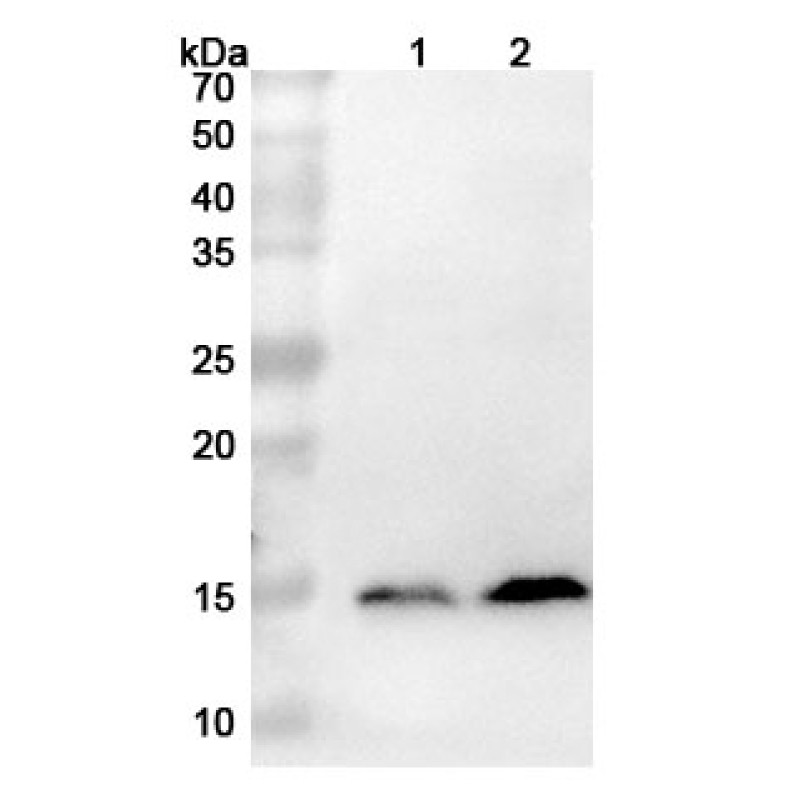
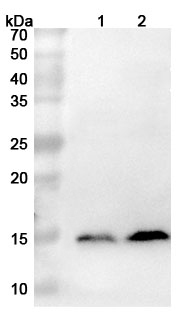 Western blot
Western blot analysis was performed using anti-S100A9 polyclonal antibody at 1ug/mL on various samples.
Lane 1: THP-1 cell lysate
Lane 2: MCF-7 cell lysate
Datasheet