
Anti-RAD50 Polyclonal Antibody
- Catalog number: PA11231
- Availability: In Stock
$168.00
- Ex Tax: $168.00
- Description: Anti-RAD50 Polyclonal Antibody (PA11231) is a rabbit polyclonal antibody detecting RAD50 in ELISA, IHC, WB. Suitable for Human, Mouse, and Rat.
Highlights:
• Affinity Purified — Minimal background and high purity for reliable results.
• Multi-Application — Validated across multiple applications.
• Multi-Species — Cross-reactive for translational research. - Host species: Rabbit
- Species reactivity: Human, Mouse, Rat
- Immunogen: E. coli - derived recombinant Human RAD50 (Thr437-Val792).
- Form: Liquid
- Storage buffer: 0.01M PBS, pH 7.4, 50% Glycerol, 0.05% Proclin 300.
- Clonality: Polyclonal
- Isotype: IgG
- Applications: ELISA, IHC, WB
- Target: RAD50,hRAD50,DNA repair protein RAD50
- Purification: Purified by antigen affinity column.
- Stability and Storage: Use a manual defrost freezer and avoid repeated freeze thaw cycles. Store at 2 to 8°C for frequent use. Store at -20 to -80°C for twelve months from the date of receipt.
- Background: DNA repair protein RAD50 is a ~153 kDa protein. Component of the MRN complex, which plays a central role in double-strand break (DSB) repair, DNA recombination, maintenance of telomere integrity and meiosis. The MRN complex is involved in the repair of DNA double-strand breaks (DSBs) via homologous recombination (HR), an error-free mechanism which primarily occurs during S and G2 phases. The complex (1) mediates the end resection of damaged DNA, which generates proper single-stranded DNA, a key initial steps in HR, and is (2) required for the recruitment of other repair factors and efficient activation of ATM and ATR upon DNA damage. The MRN complex possesses single-strand endonuclease activity and double-strand-specific 3'-5' exonuclease activity, which are provided by MRE11, to initiate end resection, which is required for single-strand invasion and recombination. Within the complex, RAD50 is both required to bind DNA ends and hold them in close proximity and regulate the activity of MRE11.
References:
1. Lee, JH. et al. (2004) Science (New York, N.Y.) 304, 93-6. PMID: 15064416
2. Gatei, M. et al. (2011) The Journal of biological chemistry 286, 31542-56. PMID: 2175778
3. Anand, R. et al. (2016) Molecular cell 64, 940-950. PMID: 27889449
4. Park, YB. et al. (2017) Nature structural & molecular biology 24, 248-257. PMID: 28134932
5. Myler, LR. et al. (2017) Molecular cell 67, 891-898.e4. PMID: 28867292
6. Carney, JP. et al. (1998) Cell 93, 477-86. PMID: 9590181
7. Paull, TT. et al. (1998) Molecular cell 1, 969-79. PMID: 965158
8. Trujillo, KM. et al. (1998) The Journal of biological chemistry 273, 21447-50. PMID: 9705271
9. de Jager, M. et al. (2001) Molecular cell 8, 1129-35. PMID: 11741547 - Note: For research use only.
Images
-
 Western blot
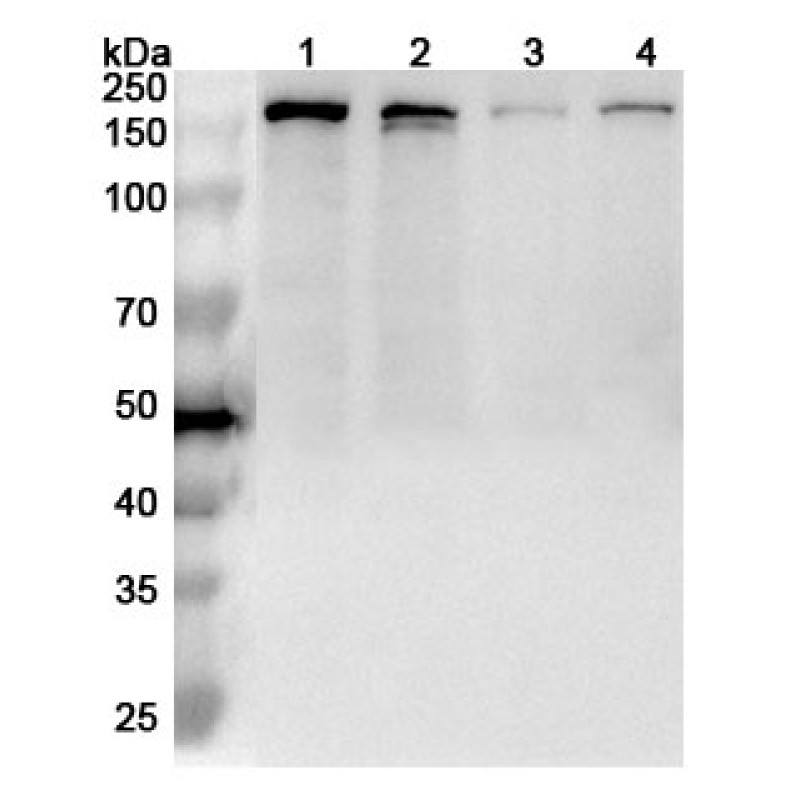
Western blot analysis was performed using anti-RAD50 polyclonal antibody at 1ug/mL on various samples.
Lane 1: K562 cell lysate
Lane 2: MCF-7 cell lysate
Lane 3: MOLT-4 cell lysate
Lane 4: PC-12 cell lysate
Datasheet