

Anti-RTCB Polyclonal Antibody
- Catalog number: PA12776
- Availability: In Stock
$168.00
- Ex Tax: $168.00
- Host species: Rabbit
- Species reactivity: Human, Mouse, Rat
- Immunogen: E. coli - derived recombinant Human RTCB (Met1-Gly505).
- Form: Liquid
- Storage buffer: 0.01M PBS, pH 7.4, 50% Glycerol, 0.05% Proclin 300.
- Clonality: Polyclonal
- Isotype: IgG
- Applications: ELISA, IHC, WB
- Target: C22orf28, RNA-splicing ligase RtcB homolog, RTCB, 3'-phosphate/5'-hydroxy nucleic acid ligase
- Purification: Purified by antigen affinity column.
- Stability and Storage: Use a manual defrost freezer and avoid repeated freeze thaw cycles. Store at 2 to 8°C for frequent use. Store at -20 to -80°C for twelve months from the date of receipt.
- Background: RNA-splicing ligase RTCB is a ~55 kDa protein. 3'-5' RNA ligase, catalytic subunit of the tRNA-splicing ligase complex (tRNA-LC), which is involved in the enzyme-dependent maturation of intron-containing pre-tRNAs. Functions downstream of the tRNA-splicing endonuclease that removes introns, ligating the two generated halves via phosphodiester bond formation. The ligation reaction, which requires guanosine triphosphate (GTP) and Mn(2+), proceeds through three metal-dependent steps. The first step requires ZBTB8OS/Archease and involves the guanylylation of RTCB at its active site histidine, forming a covalent GMP-histidine intermediate. Before the second step, RTCB also hydrolyzes the 2',3'-cyclic phosphate (cP) at the 3' end of the 5' tRNA exon, typically generated by the tRNA-splicing endonuclease, producing a 3' phosphate.
References:
1. Loeff, L. et al. (2025) Nature structural & molecular biology 32, 1205-1212. PMID: 40069351
2. Popow, J. et al. (2014) Nature 511, 104-7. PMID: 2487023
3. Gerber, JL. et al. (2024) Nature communications 15, 2378. PMID: 38493148
4. Jurkin, J. et al. (2014) The EMBO journal 33, 2922-36. PMID: 25378478
5. Peschek, J. et al. (2015) EMBO reports 16, 1688-98. PMID: 26483401 - Note: For research use only.
Images
-
 Immunofluorescence
A549 cells were fixed with 4% paraformaldehyde for 20 minutes, followed by blocking with 5% goat serum for 1 hour. The cells were then incubated with a primary antibody targeting RTCB (HV728014) at a concentration of 31.5 ug/ml overnight at 4°C. Afterward, the cells were incubated with a secondary antibody, Goat Anti-Rabbit IgG (Alexa Fluor-488) for 50 minutes at room temperature. The localization of RTCB was visualized (shown in green), and nuclear DNA was stained with DAPI (shown in blue).
-
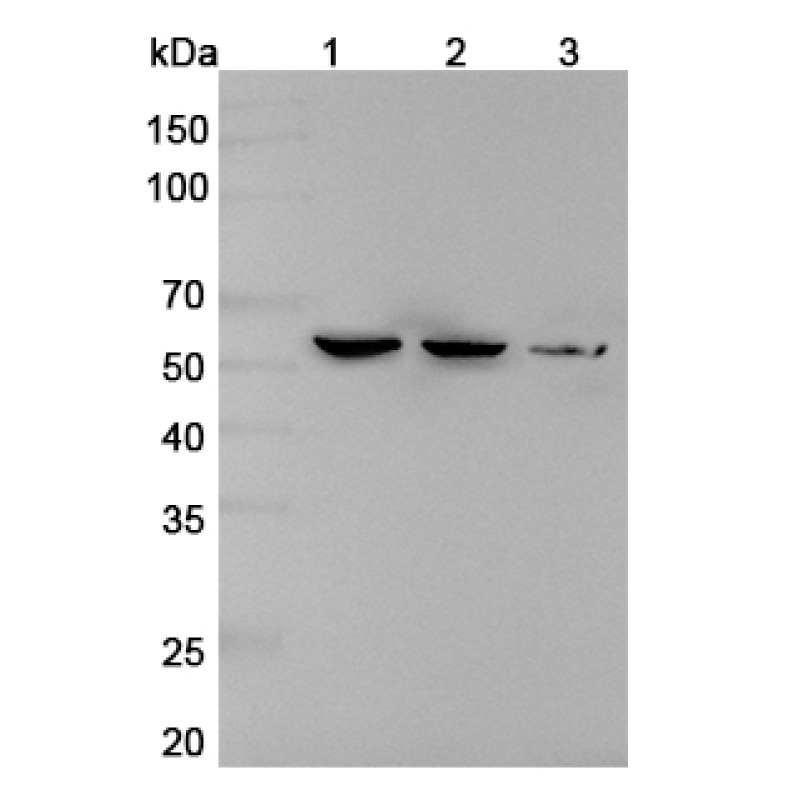
 Western blot
Western blot analysis was performed using anti-RTCB polyclonal antibody at 1μg/ml on various samples.
Lane 1: 293T cell lysate
Lane 2: Jurkat cell lysate
Lane 3: Mouse liver lysate
Datasheet