


Anti-Human MS4A1 & CD3E Bispecific Reference Antibody (Plamotamab, RUO)
- Catalog number: BS10099
- Availability: In Stock
$482.00
- Ex Tax: $482.00
Description: Research Grade Plamotamab (BS10099) is a humanized monoclonal antibody detecting B-lymphocyte surface antigen B1 in ELISA, Bioactivity: FACS, Functional assay, Research in vivo. Suitable for Human.
Highlights:
• Multi-Application — Validated across multiple applications.
Host species: Humanized
Isotype: IgG1-kappa/scFv-h-CH2-CH3
Species reactivity: Human
Immunogen:
Form: Liquid
Storage instructions:
Storage buffer: 0.01M PBS, pH7.4.
Concentration: 1mg/ml
Purity: >95% as determined by SDS-PAGE.
Clonality: Monoclonal
Applications: Research Grade Biosimilar
Target: B-lymphocytesurfaceantigenB1,Membrane-spanning4-domainssubfamilyAmember1,MS4A1,LeukocytesurfaceantigenLeu-16,B-lymphocyteantigenCD20,Bp35,CD20,T3E,T-cellsurfaceantigenT3/Leu-4epsilonchain,CD3e,CD3E,T-cellsurfaceglycoproteinCD3epsilonchain
Purification: Protein A/G purified from cell culture supernatant.
Endotoxin level: <1EU/mg, determined by LAL gel clotting assay
Expression system: Mammalian Cells
Stability and Storage: Use a manual defrost freezer and avoid repeated freeze-thaw cycles. Store at 4°C short term (1-2 weeks). Store at -20°C 12 months. Store at -80°C long term.
Alternative Names: Bispecific,XmAb-13676,CAS:2138442-31-4
Background: Epcoritamab (DuoBody-CD3xCD20, GEN3013) is a novel bispecific IgG1 antibody redirecting T-cells toward CD20+ tumor cells. Here, we assessed the preclinical efficacy of epcoritamab against primary tumor cells present in the lymph node biopsies from newly diagnosed (ND) and relapsed/refractory (RR) B-NHL patients. In the presence of T-cells from a healthy donor, epcoritamab demonstrated potent activity against primary tumor cells, irrespective of prior treatments, including CD20 mAbs. Median lysis of 65, 74, and 84% were achieved in diffuse large B-cell lymphoma (n = 16), follicular lymphoma (n = 15), and mantle cell lymphoma (n = 8), respectively. Furthermore, in this allogeneic setting, we discovered that the capacity of B-cell tumors to activate T-cells was heterogeneous and showed an inverse association with their surface expression levels of the immune checkpoint molecule Herpesvirus Entry Mediator (HVEM). In the autologous setting, when lymph node (LN)-residing T-cells were the only source of effector cells, the epcoritamab-dependent cytotoxicity strongly correlated with local effector cell-to-target cell ratios. Further analyses revealed that LN-residing-derived or peripheral blood-derived T-cells of B-NHL patients, as well as heathy donor T-cells equally mediated epcoritamab-dependent cytotoxicity. These results show the promise of epcoritamab for treatment of newly-diagnosed or relapsed/refractory B-NHL patients, including those who became refractory to previous CD20-directed therapies.
Note: For research use only. Not suitable for clinical or therapeutic use.
Highlights:
• Multi-Application — Validated across multiple applications.
Host species: Humanized
Isotype: IgG1-kappa/scFv-h-CH2-CH3
Species reactivity: Human
Immunogen:
Form: Liquid
Storage instructions:
Storage buffer: 0.01M PBS, pH7.4.
Concentration: 1mg/ml
Purity: >95% as determined by SDS-PAGE.
Clonality: Monoclonal
Applications: Research Grade Biosimilar
Target: B-lymphocytesurfaceantigenB1,Membrane-spanning4-domainssubfamilyAmember1,MS4A1,LeukocytesurfaceantigenLeu-16,B-lymphocyteantigenCD20,Bp35,CD20,T3E,T-cellsurfaceantigenT3/Leu-4epsilonchain,CD3e,CD3E,T-cellsurfaceglycoproteinCD3epsilonchain
Purification: Protein A/G purified from cell culture supernatant.
Endotoxin level: <1EU/mg, determined by LAL gel clotting assay
Expression system: Mammalian Cells
Stability and Storage: Use a manual defrost freezer and avoid repeated freeze-thaw cycles. Store at 4°C short term (1-2 weeks). Store at -20°C 12 months. Store at -80°C long term.
Alternative Names: Bispecific,XmAb-13676,CAS:2138442-31-4
Background: Epcoritamab (DuoBody-CD3xCD20, GEN3013) is a novel bispecific IgG1 antibody redirecting T-cells toward CD20+ tumor cells. Here, we assessed the preclinical efficacy of epcoritamab against primary tumor cells present in the lymph node biopsies from newly diagnosed (ND) and relapsed/refractory (RR) B-NHL patients. In the presence of T-cells from a healthy donor, epcoritamab demonstrated potent activity against primary tumor cells, irrespective of prior treatments, including CD20 mAbs. Median lysis of 65, 74, and 84% were achieved in diffuse large B-cell lymphoma (n = 16), follicular lymphoma (n = 15), and mantle cell lymphoma (n = 8), respectively. Furthermore, in this allogeneic setting, we discovered that the capacity of B-cell tumors to activate T-cells was heterogeneous and showed an inverse association with their surface expression levels of the immune checkpoint molecule Herpesvirus Entry Mediator (HVEM). In the autologous setting, when lymph node (LN)-residing T-cells were the only source of effector cells, the epcoritamab-dependent cytotoxicity strongly correlated with local effector cell-to-target cell ratios. Further analyses revealed that LN-residing-derived or peripheral blood-derived T-cells of B-NHL patients, as well as heathy donor T-cells equally mediated epcoritamab-dependent cytotoxicity. These results show the promise of epcoritamab for treatment of newly-diagnosed or relapsed/refractory B-NHL patients, including those who became refractory to previous CD20-directed therapies.
Note: For research use only. Not suitable for clinical or therapeutic use.
Images
-
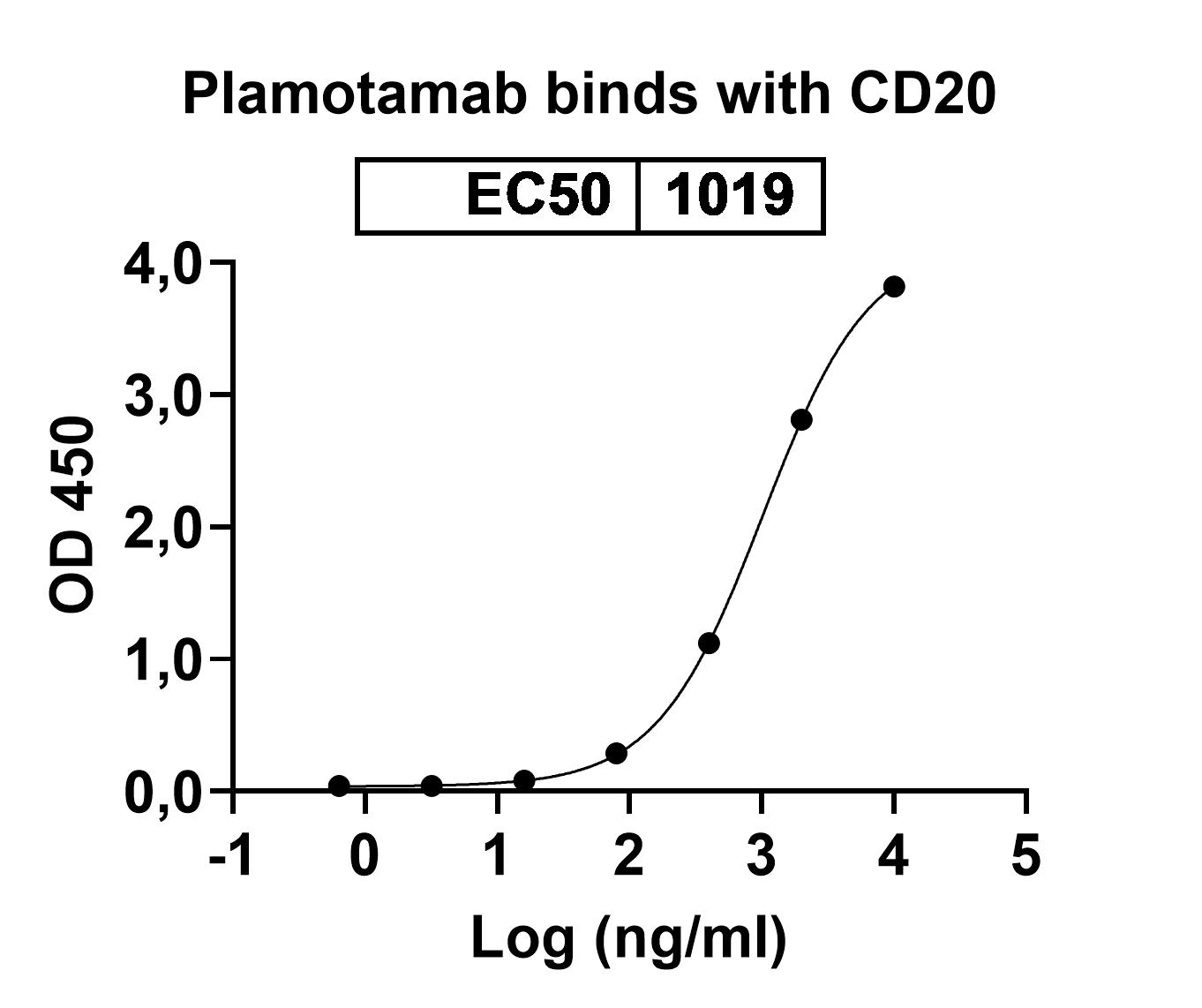 Bioactivity
Detects Recombinant Human CD20/MS4A1 Protein, N-His (Cat No.: PH10895) in indirect ELISA.
-
 SDS-PAGE
SDS-PAGE for Research Grade Plamotamab.