


Anti-Human SNCA Reference Antibody (MEDI1341)
- Catalog number: BS11502
- Availability: In Stock
$326.00
- Ex Tax: $326.00
Description: Anti-Human SNCA (MEDI1341) (BS11502) is a research-grade recombinant antibody targeting Alpha-synuclein. Produced in mammalian cells with native-like glycosylation.
Highlights:
• Research Grade — For PK/PD studies, assay development, and ADA research.
• Native Glycosylation — Mammalian expression ensures native-like patterns.
Host species: Human
Isotype: IgG4-kappa
Species reactivity: Human
Immunogen:
Form: Liquid
Storage instructions:
Storage buffer: 0.01M PBS, pH7.4.
Concentration: 1mg/ml
Purity: >95% as determined by SDS-PAGE.
Clonality: Monoclonal
Applications: Research Grade Biosimilar
Target: Alpha-synuclein,PARK1,Non-A4componentofamyloidprecursor,NACP,Non-AbetacomponentofADamyloid,SNCA
Purification: Protein A/G purified from cell culture supernatant.
Endotoxin level: <1EU/mg, determined by LAL gel clotting assay
Expression system: Mammalian Cells
Stability and Storage: Use a manual defrost freezer and avoid repeated freeze-thaw cycles. Store at 4°C short term (1-2 weeks). Store at -20°C 12 months. Store at -80°C long term.
Alternative Names: as1o0452ng1-3,MEDI1341
Background: Alpha-synuclein (SNCA) is a ~14 kDa protein. Neuronal protein that plays several roles in synaptic activity such as regulation of synaptic vesicle trafficking and subsequent neurotransmitter release. Participates as a monomer in synaptic vesicle exocytosis by enhancing vesicle priming, fusion and dilation of exocytotic fusion pores. Mechanistically, acts by increasing local Ca(2+) release from microdomains which is essential for the enhancement of ATP-induced exocytosis. Also acts as a molecular chaperone in its multimeric membrane-bound state, assisting in the folding of synaptic fusion components called SNAREs (Soluble NSF Attachment Protein REceptors) at presynaptic plasma membrane in conjunction with cysteine string protein-alpha/DNAJC5. This chaperone activity is important to sustain normal SNARE-complex assembly during aging.
References:
1. Burré, J. et al. (2010) Science (New York, N.Y.) 329, 1663-7. PMID: 20798282
2. Butler, B. et al. (2015) The Journal of biological chemistry 290, 29542-54. PMID: 2644259
3. Logan, T. et al. (2017) Nature neuroscience 20, 681-689. PMID: 28288128
4. Huang, CC. et al. (2018) Journal of cell science 131. PMID: 30404828
Note: For research use only. Not suitable for clinical or therapeutic use.
Highlights:
• Research Grade — For PK/PD studies, assay development, and ADA research.
• Native Glycosylation — Mammalian expression ensures native-like patterns.
Host species: Human
Isotype: IgG4-kappa
Species reactivity: Human
Immunogen:
Form: Liquid
Storage instructions:
Storage buffer: 0.01M PBS, pH7.4.
Concentration: 1mg/ml
Purity: >95% as determined by SDS-PAGE.
Clonality: Monoclonal
Applications: Research Grade Biosimilar
Target: Alpha-synuclein,PARK1,Non-A4componentofamyloidprecursor,NACP,Non-AbetacomponentofADamyloid,SNCA
Purification: Protein A/G purified from cell culture supernatant.
Endotoxin level: <1EU/mg, determined by LAL gel clotting assay
Expression system: Mammalian Cells
Stability and Storage: Use a manual defrost freezer and avoid repeated freeze-thaw cycles. Store at 4°C short term (1-2 weeks). Store at -20°C 12 months. Store at -80°C long term.
Alternative Names: as1o0452ng1-3,MEDI1341
Background: Alpha-synuclein (SNCA) is a ~14 kDa protein. Neuronal protein that plays several roles in synaptic activity such as regulation of synaptic vesicle trafficking and subsequent neurotransmitter release. Participates as a monomer in synaptic vesicle exocytosis by enhancing vesicle priming, fusion and dilation of exocytotic fusion pores. Mechanistically, acts by increasing local Ca(2+) release from microdomains which is essential for the enhancement of ATP-induced exocytosis. Also acts as a molecular chaperone in its multimeric membrane-bound state, assisting in the folding of synaptic fusion components called SNAREs (Soluble NSF Attachment Protein REceptors) at presynaptic plasma membrane in conjunction with cysteine string protein-alpha/DNAJC5. This chaperone activity is important to sustain normal SNARE-complex assembly during aging.
References:
1. Burré, J. et al. (2010) Science (New York, N.Y.) 329, 1663-7. PMID: 20798282
2. Butler, B. et al. (2015) The Journal of biological chemistry 290, 29542-54. PMID: 2644259
3. Logan, T. et al. (2017) Nature neuroscience 20, 681-689. PMID: 28288128
4. Huang, CC. et al. (2018) Journal of cell science 131. PMID: 30404828
Note: For research use only. Not suitable for clinical or therapeutic use.
Images
-
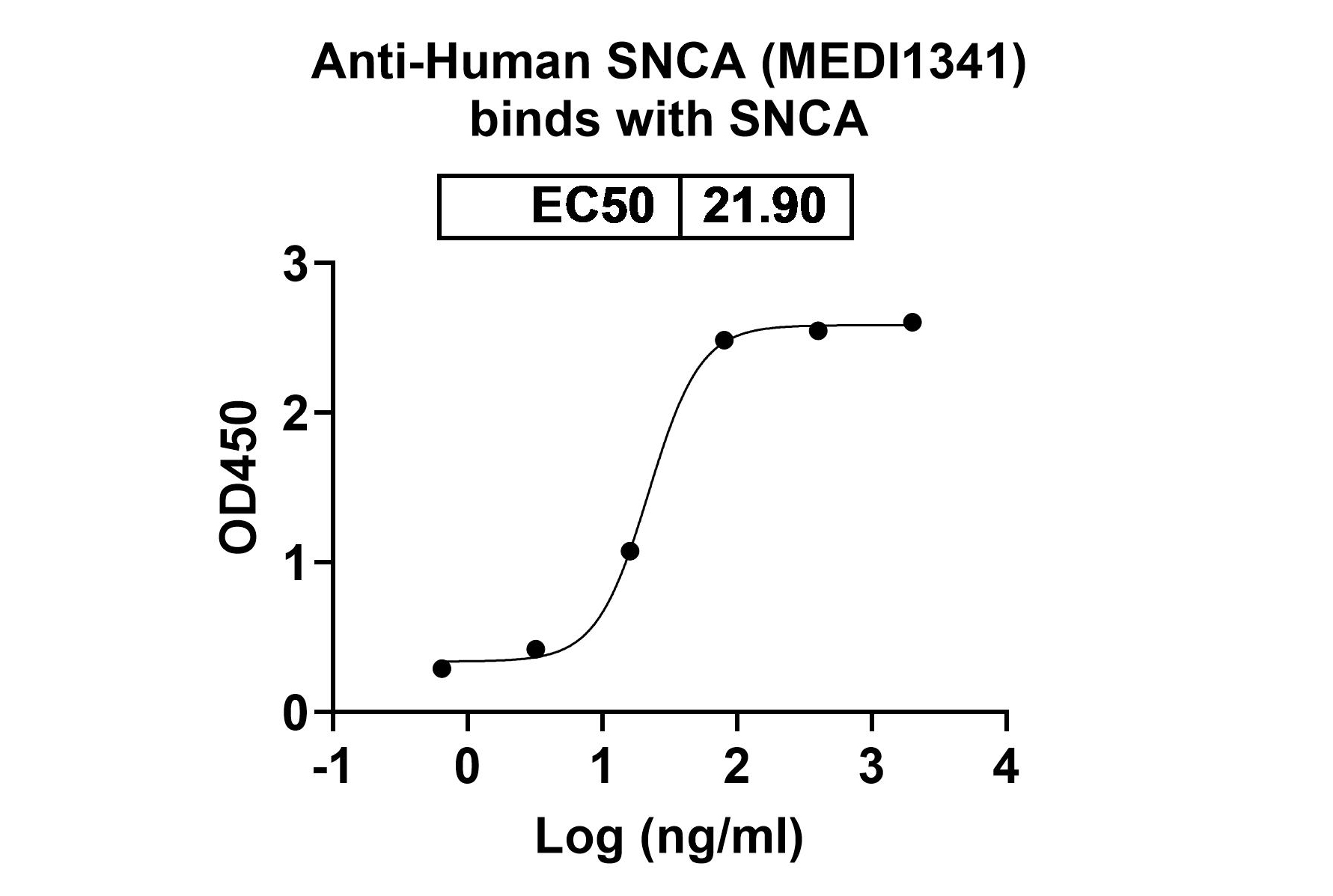 Bioactivity
Detects SNCA in indirect ELISAs.
-
 SDS-PAGE
SDS-PAGE for Research Grade Anti-Human SNCA (MEDI1341).
-
 Western blot
Western blot analysis was performed using anti-SNCA monoclonal antibody at 1μg/ml on various samples.
Lane 1: recombinant human SNCA (Catalog No: PH11525), 50ng
Lane 2: recombinant human SNCA (Catalog No: PH11525), 30ng
Lane 3: recombinant human SNCA (Catalog No: PH11525), 20ng
Lane 4: recombinant human SNCA (Catalog No: PH11525), 10ng