
Anti-HSPA5 Polyclonal Antibody
- Catalog number: PA14435
- Availability: In Stock
$168.00
- Ex Tax: $168.00
- Description: Anti-HSPA5 Polyclonal Antibody (PA14435) is a rabbit polyclonal antibody detecting HSPA5 in ELISA, IHC, WB. Suitable for Human and Mouse.
Highlights:
• Affinity Purified — Minimal background and high purity for reliable results.
• Multi-Application — Validated across multiple applications. - Host species: Rabbit
- Species reactivity: Human, Mouse
- Immunogen: E. coli - derived recombinant Human HSPA5 (Leu351-Leu654).
- Form: Liquid
- Storage buffer: 0.01M PBS, pH 7.4, 50% Glycerol, 0.05% Proclin 300.
- Clonality: Polyclonal
- Isotype: IgG
- Applications: ELISA, IHC, WB
- Target: Heat shock protein 70 family protein 5, 78 kDa glucose-regulated protein, HSPA5, Binding-immunoglobulin protein, GRP-78, HSP70 family protein 5, Heat shock protein family A member 5, Endoplasmic reticulum chaperone BiP, GRP78, BiP, Immunoglobulin heavy chain-binding protein
- Purification: Purified by antigen affinity column.
- Stability and Storage: Use a manual defrost freezer and avoid repeated freeze thaw cycles. Store at 2 to 8°C for frequent use. Store at -20 to -80°C for twelve months from the date of receipt.
- Background: Endoplasmic reticulum chaperone BiP (HSPA5/GRP78) is a ~72 kDa protein. Endoplasmic reticulum chaperone that plays a key role in protein folding and quality control in the endoplasmic reticulum lumen. Involved in the correct folding of proteins and degradation of misfolded proteins via its interaction with DNAJC10/ERdj5, probably to facilitate the release of DNAJC10/ERdj5 from its substrate. Acts as a key repressor of the EIF2AK3/PERK and ERN1/IRE1-mediated unfolded protein response (UPR). In the unstressed endoplasmic reticulum, recruited by DNAJB9/ERdj4 to the luminal region of ERN1/IRE1, leading to disrupt the dimerization of ERN1/IRE1, thereby inactivating ERN1/IRE1. Also binds and inactivates EIF2AK3/PERK in unstressed cells.
References:
1. Dana, RC. et al. (1990) Endocrinology 126, 672-4. PMID: 229401
2. Oka, OB. et al. (2013) Molecular cell 50, 793-804. PMID: 23769672
3. Evensen, NA. et al. (2013) Journal of the National Cancer Institute 105, 1402-16. PMID: 23990668
4. Cuevas, EP. et al. (2017) Scientific reports 7, 44988. PMID: 28332555
5. Ma, K. et al. (2002) The Journal of biological chemistry 277, 18728-35. PMID: 11907036
6. Ng, DT. et al. (1992) Molecular biology of the cell 3, 143-55. PMID: 1550958
7. Oikawa, D. et al. (2009) Experimental cell research 315, 2496-504. PMID: 19538957
8. Kovaleva, V. et al. (2023) Cell reports 42, 112066. PMID: 36739529
9. Kang, JM. et al. (2015) Cancer research 75, 3087-97. PMID: 26045166 - Note: For research use only.
Images
-
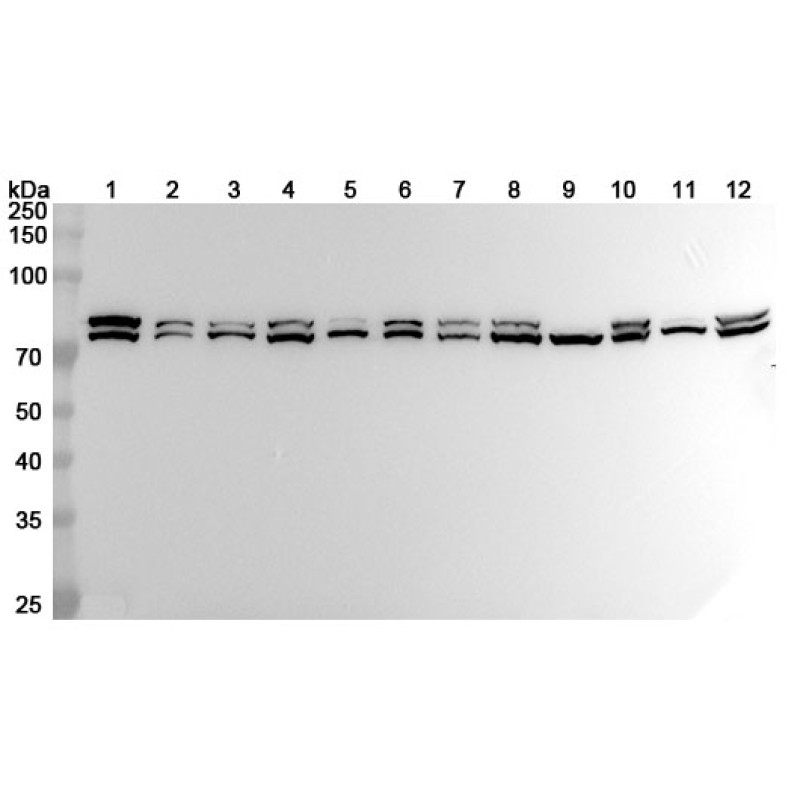
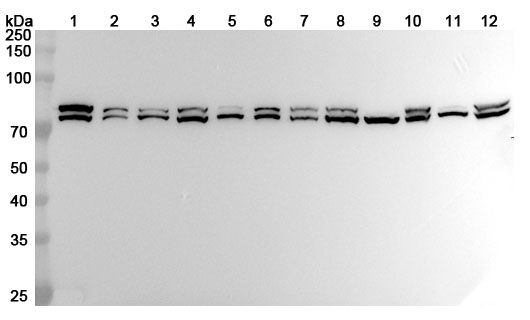 Western blot
Western blot analysis was performed using anti-HSPA5 polyclonal antibody at 1ug/mL on various samples.
Lane 1: HepG2 cell lysate
Lane 2: NIH3T3 cell lysate
Lane 3: 4T1 cell lysate
Lane 4: MCF-7 cell lysate
Lane 5: Jurkat cell lysate
Lane 6: PC-12 cell lysate
Lane 7: Hela cell lysate
Lane 8: A549 cell lysate
Lane 9: Mouse brain lysate
Lane 10: Mouse liver lysate
Lane11: Rat brain lysate
Lane12: Rat liver lysate
Datasheet