
Anti-Human RET/c-RET Antibody (SAA1768)
- Catalog number: RA12412
- Availability: In Stock
$196.00
- Ex Tax: $196.00
Description: Anti-Human RET/c-RET Antibody (SAA1768) [SAA1768] (RA12412) is a mouse monoclonal antibody detecting RET in ELISA. Suitable for Human.
Host species: Mouse
Isotype: IgG2a, kappa
Species reactivity: Human
Form: Liquid
Storage buffer: 0.01M PBS, pH 7.4.
Concentration: 1 mg/ml
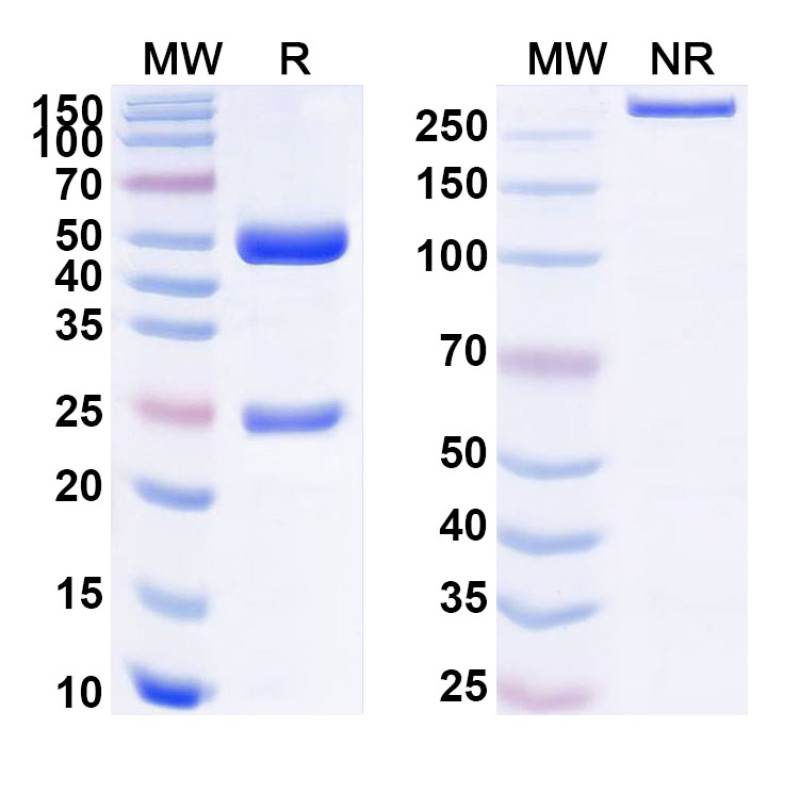
Purity: >95% as determined by SDS-PAGE.
Clonality: Monoclonal
Applications: ELISA
Target: RET51, Proto-oncogene c-Ret, Cadherin family member 12, RET, Proto-oncogene tyrosine-protein kinase receptor Ret, CDHF12, CDHR16, PTC
Purification: Protein A/G purified from cell culture supernatant.
Endotoxin level: Please contact with the lab for this information.
Stability and Storage: Use a manual defrost freezer and avoid repeated freeze-thaw cycles. Store at 4°C short term (1-2 weeks). Store at -20°C 12 months. Store at -80°C long term.
Alternative Names:
Background: Proto-oncogene tyrosine-protein kinase receptor Ret (c-RET) is a ~124 kDa protein. Receptor tyrosine-protein kinase involved in numerous cellular mechanisms including cell proliferation, neuronal navigation, cell migration, and cell differentiation in response to glia cell line-derived growth family factors (GDNF, NRTN, ARTN, PSPN and GDF15). In contrast to most receptor tyrosine kinases, RET requires not only its cognate ligands but also coreceptors, for activation. GDNF ligands (GDNF, NRTN, ARTN, PSPN and GDF15) first bind their corresponding GDNFR coreceptors (GFRA1, GFRA2, GFRA3, GFRA4 and GFRAL, respectively), triggering RET autophosphorylation and activation, leading to activation of downstream signaling pathways, including the MAPK- and AKT-signaling pathways. Acts as a dependence receptor via the GDNF-GFRA1 signaling: in the presence of the ligand GDNF in somatotrophs within pituitary, promotes survival and down regulates growth hormone (GH) production, but triggers apoptosis in absence of GDNF. Required for the molecular mechanisms orchestration during intestine organogenesis via the ARTN-GFRA3 signaling: involved in the development of enteric nervous system and renal organogenesis during embryonic life, and promotes the formation of Peyer's patch-like structures, a major component of the gut-associated lymphoid tissue.
References:
1. Ma, Q. (2009) Neuron 64, 773-6. PMID: 20064382
2. Garcia-Lavandeira, M. et al. (2010) Frontiers of hormone research 38, 127-138. PMID: 20616503
3. Cockburn, JG. et al. (2010) The Journal of clinical endocrinology and metabolism 95, E342-6. PMID: 20702524
4. Cabrera, JR. et al. (2011) The Journal of biological chemistry 286, 14628-38. PMID: 2135769
5. Plaza-Menacho, I. et al. (2011) The Journal of biological chemistry 286, 17292-302. PMID: 21454698
6. Plaza-Menacho, I. et al. (2014) Molecular cell 53, 738-51. PMID: 24560924
7. Mullican, SE. et al. (2017) Nature medicine 23, 1150-1157. PMID: 28846097
8. Yang, L. et al. (2017) Nature medicine 23, 1158-1166. PMID: 28846099
9. Hsu, JY. et al. (2017) Nature 550, 255-259. PMID: 28953886
10. Terzyan, SS. et al. (2019) The Journal of biological chemistry 294, 10428-10437. PMID: 31118272
Note: For research use only.
Images
-
 SDS-PAGE
SDS-PAGE for Anti-Human RET/c-RET Antibody (SAA1768)