
Anti-Human IFNAR1 Antibody (SAA0119)
- Catalog number: FC10085
- Availability: In Stock
$191.00
- Ex Tax: $191.00
- Description: Anti-Human IFNAR1 Antibody (SAA0119) [SAA0119] (FC10085) is a human monoclonal antibody detecting IFNAR1 in ELISA, FCM, IHC. Suitable for Human.
Highlights:
• Multi-Application — Validated across multiple applications.
• Flow Cytometry — Validated for flow cytometry applications. - Model: HB823107
- Name: Anti-Human IFNAR1 Antibody (SAA0119)
- Host species: Human
- Isotype: IgG1, kappa
- Conjugation: Unconjugated
- Species reactivity: Human
- Form: Liquid
- Storage buffer: 0.01M PBS, pH 7.4.
- Concentration: 1 mg/ml
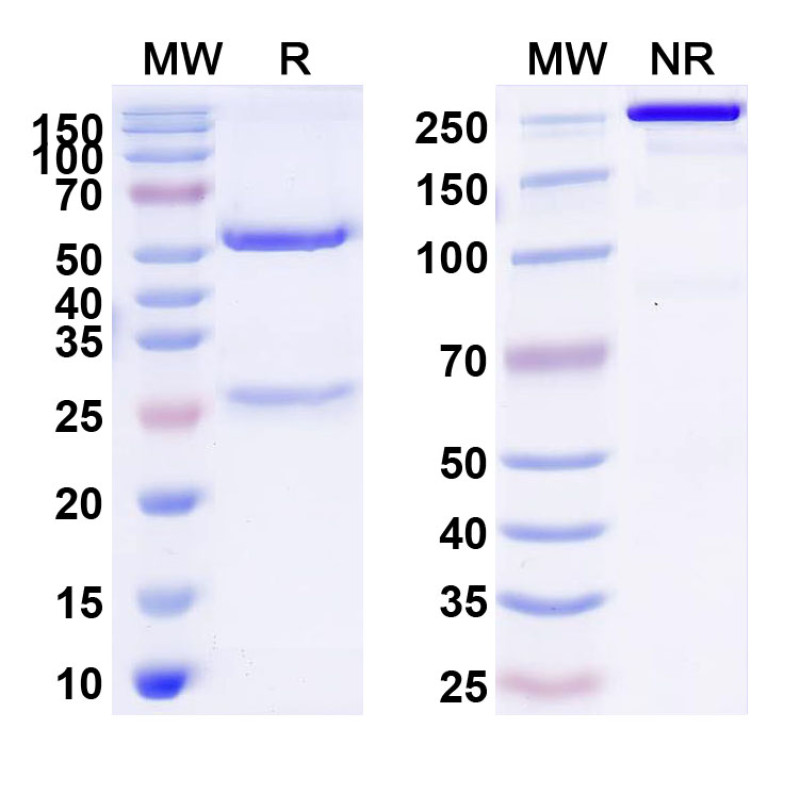
- Purity: >95% as determined by SDS-PAGE.
- Clonality: Monoclonal
- Applications: ELISA, FCM, IHC
- Target: Interferon alpha/beta receptor 1, Cytokine receptor family 2 member 1, Cytokine receptor class-II member 1, CRF2-1, IFN-R-1, IFNAR1, IFNAR, IFN-alpha/beta receptor 1, Type I interferon receptor 1
- Purification: Protein A/G purified from cell culture supernatant.
- Endotoxin level: Please contact with the lab for this information.
- Stability and Storage: Use a manual defrost freezer and avoid repeated freeze-thaw cycles. Store at 4°C short term (1-2 weeks). Store at -20°C 12 months. Store at -80°C long term.
- Background: Interferon alpha/beta receptor 1 (IFNAR1) is a ~63 kDa protein. Together with IFNAR2, forms the heterodimeric receptor for type I interferons (including interferons alpha, beta, epsilon, omega and kappa). Type I interferon binding activates the JAK-STAT signaling cascade, resulting in transcriptional activation or repression of interferon-regulated genes that encode the effectors of the interferon response. Mechanistically, type I interferon-binding brings the IFNAR1 and IFNAR2 subunits into close proximity with one another, driving their associated Janus kinases (JAKs) (TYK2 bound to IFNAR1 and JAK1 bound to IFNAR2) to cross-phosphorylate one another. The activated kinases phosphorylate specific tyrosine residues on the intracellular domains of IFNAR1 and IFNAR2, forming docking sites for the STAT transcription factors. STAT proteins are then phosphorylated by the JAKs, promoting their translocation into the nucleus to regulate expression of interferon-regulated genes.
References:
1. Russell-Harde, D. et al. (1999) Biochemical and biophysical research communications 255, 539-44. PMID: 10049744
2. Kumar, KG. et al. (2003) The EMBO journal 22, 5480-90. PMID: 1453212
3. Kumar, KG. et al. (2004) The Journal of biological chemistry 279, 46614-20. PMID: 1533777
4. Uzé, G. et al. (1990) Cell 60, 225-34. PMID: 2153461
5. Thomas, C. et al. (2011) Cell 146, 621-32. PMID: 21854986
6. Zheng, H. et al. (2013) Cell reports 5, 180-93. PMID: 24075985
7. Hernandez, N. et al. (2019) The Journal of experimental medicine 216, 2057-2070. PMID: 31270247
8. Gothe, F. et al. (2022) Clinical infectious diseases : an official publication of the Infectious Diseases Society of America 74, 136-139. PMID: 33252644
9. Bastard, P. et al. (2022) The Journal of experimental medicine 219. PMID: 35442418
10. Abramovich, C. et al. (1994) The EMBO journal 13, 5871-7. PMID: 7813427 - Note: For research use only.
Images
-
 SDS-PAGE
SDS-PAGE for Anti-Human IFNAR1 Antibody (SAA0119)
Datasheet