

Anti-Human CD301/CLEC10A Antibody (49C11)
- Catalog number: FC10307
- Availability: In Stock
$191.00
- Ex Tax: $191.00
- Description: Anti-Human CD301/CLEC10A Antibody (49C11) [49C11] (FC10307) is a mouse monoclonal antibody detecting CLEC10A in FCM. Suitable for Human.
Highlights:
• Flow Cytometry — Validated for flow cytometry applications. - Model: HV834107
- Name: Anti-Human CD301/CLEC10A Antibody (49C11)
- Host species: Mouse
- Isotype: IgG1, kappa
- Conjugation: Unconjugated
- Species reactivity: Human
- Form: Liquid
- Storage buffer: 0.01M PBS, pH 7.4.
- Concentration: 1.4 mg/ml
- Purity: >95% as determined by SDS-PAGE.
- Clonality: Monoclonal
- Applications: FCM
- Target: CD301, Macrophage lectin 2, C-type lectin domain family 10 member A, CLECSF13, C-type lectin superfamily member 14, CLEC10A, CLECSF14, HML
- Purification: Protein A/G purified from cell culture supernatant.
- Endotoxin level: Please contact with the lab for this information.
- Stability and Storage: Use a manual defrost freezer and avoid repeated freeze-thaw cycles. Store at 4°C short term (1-2 weeks). Store at -20°C 12 months. Store at -80°C long term.
- Background: C-type lectin domain family 10 member A (CD301/CLEC10A) is a ~35 kDa protein. C-type lectin receptor involved in recognition of N-acetylgalactosamine (GalNAc)-terminated glycans by myeloid antigen presenting cells (APCs). Binds in a Ca(2+)-dependent manner to alpha- and beta-linked GalNAc residues on glycoprotein and glycolipid antigens, including alphaGalNAc- and Galbeta1->3GalNAc-O-Ser/Thr also known as Tn and T antigens, LacdiNAc epitope GalNAcbeta1->4GlcNAc and its derivative GalNAcbeta1->4-(Fucalpha1->3)GlcNAc, O-linked core 5 and 6 glycans, and GM2 and GD2 gangliosides. Acts as a signaling receptor at the interface of APC-T cell interactions. On immature dendritic cells, recognizes Tn antigen-carrying PTPRC/CD45 receptor on effector T cells and downregulates PTRPN/CD45 phosphatase activity with an impact on T cell activation threshold, cytokine production and proliferation. Modulates dendritic cell maturation toward a tolerogenic phenotype leading to generation of regulatory CD4-positive T cell subset with immune suppressive functions.
References:
1. van Vliet, SJ. et al. (2005) International immunology 17, 661-9. PMID: 15802303
2. van Vliet, SJ. et al. (2006) Nature immunology 7, 1200-8. PMID: 16998493
3. van Vliet, SJ. et al. (2007) European journal of immunology 37, 2075-81. PMID: 17616966
4. Li, D. et al. (2012) The Journal of experimental medicine 209, 109-21. PMID: 22213806
5. Gabba, A. et al. (2021) Biochemistry 60, 1327-1336. PMID: 33724805
6. Suzuki, N. et al. (1996) Journal of immunology (Baltimore, Md. : 1950) 156, 128-35. PMID: 8598452
7. Mortezai, N. et al. (2013) Glycobiology 23, 844-52. PMID: 23507963 - Note: For research use only.
Images
-
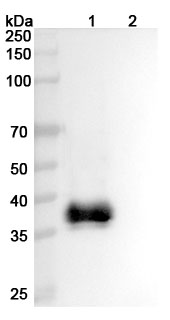 Western blot
Western blot analysis was performed using anti-CD301/CLEC10A monoclonal antibody at 1ug/mL on various samples.
Lane 1: recombinant human CD301/CLEC10A (Catalog No: PH13693)
Lane 2: negative control