


Anti-Human IL23A Antibody (SAA0392)
- Catalog number: FC10732
- Availability: In Stock
$196.00
- Ex Tax: $196.00
- Description: Anti-Human IL23A Antibody (SAA0392) [SAA0392] (FC10732) is a human monoclonal antibody detecting IL23A in ELISA, FCM. Suitable for Human.
Highlights:
• Flow Cytometry — Validated for flow cytometry applications. - Model: HV466207
- Name: Anti-Human IL23A Antibody (SAA0392)
- Host species: Human
- Isotype: IgG4, kappa
- Conjugation: Unconjugated
- Species reactivity: Human
- Form: Liquid
- Storage buffer: 0.01M PBS, pH 7.4, 0.09% Sodium azide.
- Concentration: 1 mg/ml
- Purity: >95% as determined by SDS-PAGE.
- Clonality: Monoclonal
- Applications: ELISA, FCM
- Target: SGRF, IL-23-A, IL-23 subunit alpha, Interleukin-23 subunit p19, IL23A, Interleukin-23 subunit alpha, IL-23p19
- Purification: Protein A/G purified from cell culture supernatant.
- Endotoxin level: Please contact with the lab for this information.
- Stability and Storage: Use a manual defrost freezer and avoid repeated freeze-thaw cycles. Store at 4°C short term (1-2 weeks). Store at -20°C 12 months. Store at -80°C long term.
- Background: Interleukin-23 subunit alpha (IL23A) is a ~20 kDa protein. Associates with IL12B to form the pro-inflammatory cytokine IL-23 that plays different roles in innate and adaptive immunity. Released by antigen-presenting cells such as dendritic cells or macrophages, binds to a heterodimeric receptor complex composed of IL12RB1 and IL23R to activate JAK2 and TYK2 which then phosphorylate the receptor to form a docking site leading to the phosphorylation of STAT3 and STAT4. This process leads to activation of several pathways including p38 MAPK or NF-kappa-B and promotes the production of pro-inflammatory cytokines such as interleukin-17A/IL17A. In turn, participates in the early and effective intracellular bacterial clearance. Promotes the expansion and survival of T-helper 17 cells, a CD4-positive helper T-cell subset that produces IL-17, as well as other IL-17-producing cells. IL23A is the therapeutic target of guselkumab (Tremfya).
References:
1. Oppmann, B. et al. (2000) Immunity 13, 715-25. PMID: 11114383
2. Bloch, Y. et al. (2018) Immunity 48, 45-58.e6. PMID: 29287995
3. Sun, R. et al. (2020) Cellular and molecular gastroenterology and hepatology 10, 673-697. PMID: 32474165
4. Glassman, CR. et al. (2021) Cell 184, 983-999.e24. PMID: 33606986
5. Parham, C. et al. (2002) Journal of immunology (Baltimore, Md. : 1950) 168, 5699-708. PMID: 12023369
6. Wilson, NJ. et al. (2007) Nature immunology 8, 950-7. PMID: 17676044 - Note: For research use only.
Images
-
 Bioactivity
SEC-HPLC detection for Anti-Human IL23A Antibody (ABS0131).
-
 Flow Cytometry
Flow-cytometry using anti-human IL23A antibody.IL23A Transfected CHO cells were stained with an irrelevant antibody (Blue Histogram) or an anti-human IL23A antibody monoclonal antibody (Catalog # HV466207 ,Green Histogram) at a concentration of 5 µg/ml for 30 mins at RT. After washing, bound antibody was detected using a FITC conjugated goat anti-human antibody (Catalog # HF690414) and cells analysed on a NovoCyte Flow Cytometer.
-
 Western blot
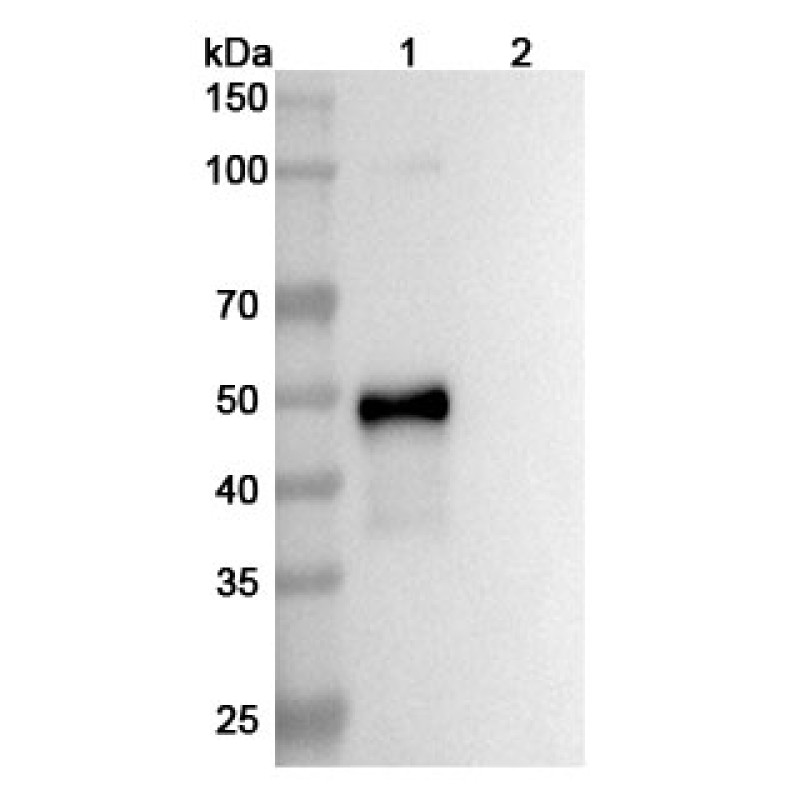
Western blot analysis was performed using anti-IL23A monoclonal antibody at 1ug/mL on various samples.
Lane 1: recombinant human IL23A (Catalog No: PH12906)
Lane 2: negative control
Datasheet