

Anti-HBsAg Reference Reference Antibody (OST 577)
- Catalog number: BS12299
- Availability: In Stock
$370.00
- Ex Tax: $370.00
Description: Anti-HBsAg Reference Antibody (OST 577) (BS12299) is a research-grade recombinant antibody targeting Large envelope protein. Produced in mammalian cells with native-like glycosylation.
Highlights:
• Research Grade — For PK/PD studies, assay development, and ADA research.
• Native Glycosylation — Mammalian expression ensures native-like patterns.
Host species: Human
Isotype: IgG1-lambda
Species reactivity: HepatitisBvirusgenotypeA2subtypeadw(isolateJapan/Nishioka/1983)(HBV-A)
Immunogen:
Form: Liquid
Storage instructions:
Storage buffer: 0.01M PBS, pH7.4.
Concentration: 1mg/ml
Purity: >95% as determined by SDS-PAGE.
Clonality: Monoclonal
Applications: Research Grade Biosimilar
Target: Largeenvelopeprotein,Lglycoprotein,L-HBsAg,LHB,LargeSprotein,Largesurfaceprotein,Majorsurfaceantigen,S
Purification: Protein A/G purified from cell culture supernatant.
Endotoxin level: <1EU/mg, determined by LAL gel clotting assay
Expression system: Mammalian Cells
Stability and Storage: Use a manual defrost freezer and avoid repeated freeze-thaw cycles. Store at 4°C short term (1-2 weeks). Store at -20°C 12 months. Store at -80°C long term.
Alternative Names: OST577,OST577,OST-577
Background: Large envelope protein (HBsAg) is a ~42 kDa protein. The large envelope protein exists in two topological conformations, one which is termed 'external' or Le-HBsAg and the other 'internal' or Li-HBsAg. In its external conformation the protein attaches the virus to cell receptors and thereby initiating infection. This interaction determines the species specificity and liver tropism. This attachment induces virion internalization predominantly through caveolin-mediated endocytosis. The large envelope protein also assures fusion between virion membrane and endosomal membrane.
Note: For research use only. Not suitable for clinical or therapeutic use.
Highlights:
• Research Grade — For PK/PD studies, assay development, and ADA research.
• Native Glycosylation — Mammalian expression ensures native-like patterns.
Host species: Human
Isotype: IgG1-lambda
Species reactivity: HepatitisBvirusgenotypeA2subtypeadw(isolateJapan/Nishioka/1983)(HBV-A)
Immunogen:
Form: Liquid
Storage instructions:
Storage buffer: 0.01M PBS, pH7.4.
Concentration: 1mg/ml
Purity: >95% as determined by SDS-PAGE.
Clonality: Monoclonal
Applications: Research Grade Biosimilar
Target: Largeenvelopeprotein,Lglycoprotein,L-HBsAg,LHB,LargeSprotein,Largesurfaceprotein,Majorsurfaceantigen,S
Purification: Protein A/G purified from cell culture supernatant.
Endotoxin level: <1EU/mg, determined by LAL gel clotting assay
Expression system: Mammalian Cells
Stability and Storage: Use a manual defrost freezer and avoid repeated freeze-thaw cycles. Store at 4°C short term (1-2 weeks). Store at -20°C 12 months. Store at -80°C long term.
Alternative Names: OST577,OST577,OST-577
Background: Large envelope protein (HBsAg) is a ~42 kDa protein. The large envelope protein exists in two topological conformations, one which is termed 'external' or Le-HBsAg and the other 'internal' or Li-HBsAg. In its external conformation the protein attaches the virus to cell receptors and thereby initiating infection. This interaction determines the species specificity and liver tropism. This attachment induces virion internalization predominantly through caveolin-mediated endocytosis. The large envelope protein also assures fusion between virion membrane and endosomal membrane.
Note: For research use only. Not suitable for clinical or therapeutic use.
Images
-
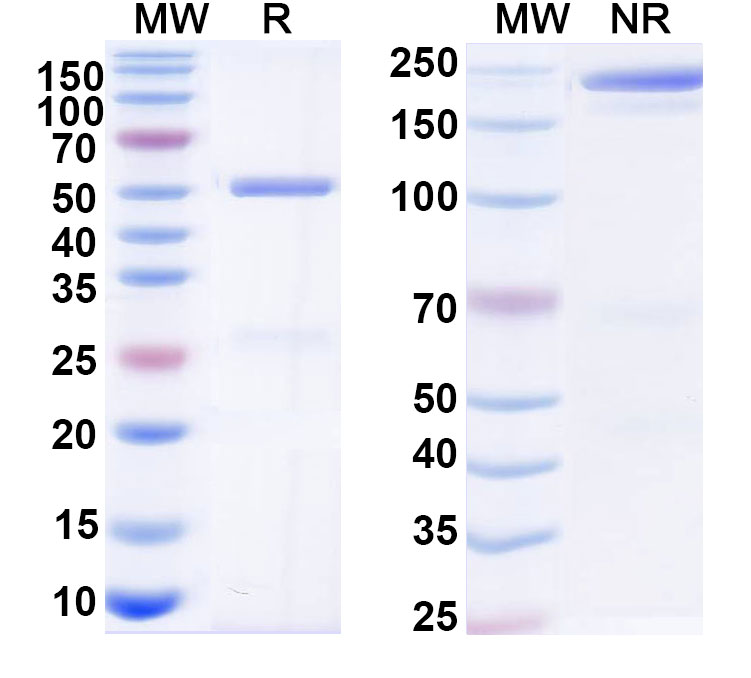 SDS-PAGE
SDS-PAGE for Research Grade Anti-HBsAg Reference Antibody (OST 577).