
Anti-ACTG1 Polyclonal Antibody
- Catalog number: PR0012
- Availability: In Stock
$168.00
- Ex Tax: $168.00
Description: Anti-ACTG1 Polyclonal Antibody (PR0012) is a rabbit polyclonal antibody detecting ACTG1 in ELISA, IHC, WB. Suitable for Human, Mouse, Dog, Rat, and Absidia glauca.
Highlights:
• Affinity Purified — Minimal background and high purity for reliable results.
• Multi-Application — Validated across multiple applications.
• Multi-Species — Cross-reactive for translational research.
Host species: Rabbit
Species reactivity: Human
Immunogen: E. coli - derived recombinant Human ACTG1 (Met1-Phe375).
Form: Liquid
Storage buffer: 0.01M PBS, pH 7.4, 50% Glycerol, 0.05% Proclin 300.
Clonality: Polyclonal
Isotype: IgG
Applications: ELISA, IHC, WB
Target: ACTG,Gamma-actin,ACTG1,Actin,cytoplasmic 2
Purification: Purified by antigen affinity column.
Stability and Storage: Use a manual defrost freezer and avoid repeated freeze thaw cycles. Store at 2 to 8°C for frequent use. Store at -20 to -80°C for twelve months from the date of receipt.
Background: Actin, cytoplasmic 1 (ACTG1) is a ~41 kDa protein. Actin is a highly conserved protein that polymerizes to produce filaments that form cross-linked networks in the cytoplasm of cells. Actin exists in both monomeric (G-actin) and polymeric (F-actin) forms, both forms playing key functions, such as cell motility and contraction. In addition to their role in the cytoplasmic cytoskeleton, G- and F-actin also localize in the nucleus, and regulate gene transcription and motility and repair of damaged DNA. Plays a role in the assembly of the gamma-tubulin ring complex (gTuRC), which regulates the minus-end nucleation of alpha-beta tubulin heterodimers that grow into microtubule protafilaments. Part of the ACTR1A/ACTB filament around which the dynactin complex is built.
References:
1. Baarlink, C. et al. (2013) Science (New York, N.Y.) 340, 864-7. PMID: 23558171
2. Plessner, M. et al. (2015) The Journal of biological chemistry 290, 11209-16. PMID: 25759381
Note: For research use only.
Highlights:
• Affinity Purified — Minimal background and high purity for reliable results.
• Multi-Application — Validated across multiple applications.
• Multi-Species — Cross-reactive for translational research.
Host species: Rabbit
Species reactivity: Human
Immunogen: E. coli - derived recombinant Human ACTG1 (Met1-Phe375).
Form: Liquid
Storage buffer: 0.01M PBS, pH 7.4, 50% Glycerol, 0.05% Proclin 300.
Clonality: Polyclonal
Isotype: IgG
Applications: ELISA, IHC, WB
Target: ACTG,Gamma-actin,ACTG1,Actin,cytoplasmic 2
Purification: Purified by antigen affinity column.
Stability and Storage: Use a manual defrost freezer and avoid repeated freeze thaw cycles. Store at 2 to 8°C for frequent use. Store at -20 to -80°C for twelve months from the date of receipt.
Background: Actin, cytoplasmic 1 (ACTG1) is a ~41 kDa protein. Actin is a highly conserved protein that polymerizes to produce filaments that form cross-linked networks in the cytoplasm of cells. Actin exists in both monomeric (G-actin) and polymeric (F-actin) forms, both forms playing key functions, such as cell motility and contraction. In addition to their role in the cytoplasmic cytoskeleton, G- and F-actin also localize in the nucleus, and regulate gene transcription and motility and repair of damaged DNA. Plays a role in the assembly of the gamma-tubulin ring complex (gTuRC), which regulates the minus-end nucleation of alpha-beta tubulin heterodimers that grow into microtubule protafilaments. Part of the ACTR1A/ACTB filament around which the dynactin complex is built.
References:
1. Baarlink, C. et al. (2013) Science (New York, N.Y.) 340, 864-7. PMID: 23558171
2. Plessner, M. et al. (2015) The Journal of biological chemistry 290, 11209-16. PMID: 25759381
Note: For research use only.
Images
-
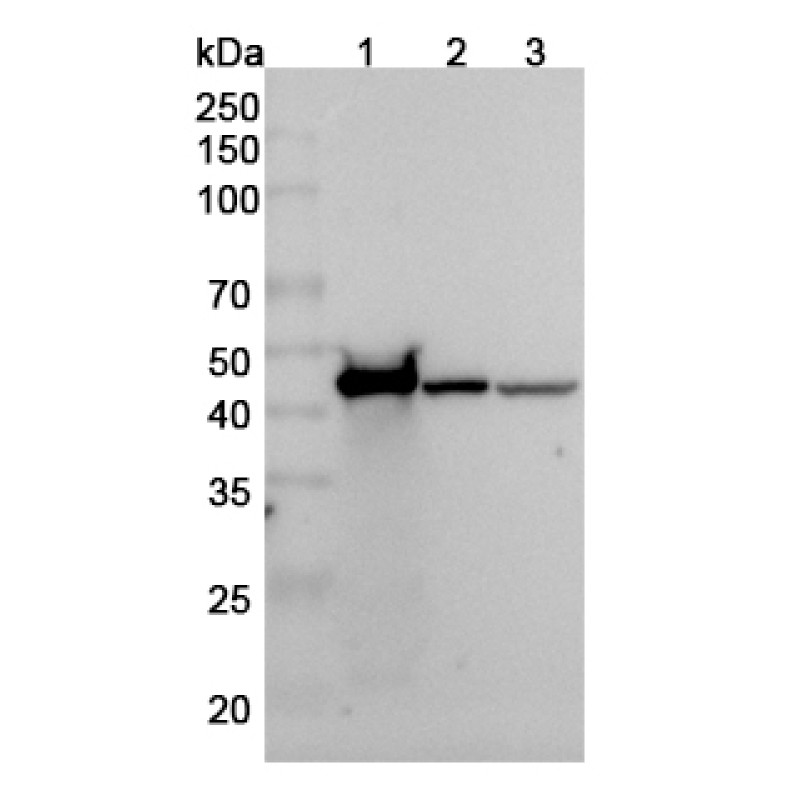
 Western blot
Western blot analysis was performed using anti-ACTG1 polyclonal antibody at 1μg/ml on various samples.
Lane 1: recombinant human ACTG1 (Catalog No: PH11911)
Lane 2: PC12 cell lysate
Lane 3: MCF7 cell lysate
Datasheet