


Anti-Human PD-1 Reference Antibody (Camrelizumab, RUO)
- Catalog number: BS10263
- Availability: In Stock
$176.00
- Ex Tax: $176.00
Description: Camrelizumab (BS10263) is a research-grade recombinant antibody targeting CD1. Produced in mammalian cells with native-like glycosylation.
Highlights:
• Research Grade — For PK/PD studies, assay development, and ADA research.
• Native Glycosylation — Mammalian expression ensures native-like patterns.
Host species: Humanized
Isotype: IgG4-kappa
Species reactivity: Human
Immunogen:
Form: Liquid
Storage instructions:
Storage buffer: 0.01M PBS, pH7.4.
Concentration: 12.5mg/ml
Purity: >95% as determined by SDS-PAGE.
Clonality: Monoclonal
Applications: Research Grade Biosimilar
Target: Programmedcelldeathprotein1,ProteinPD-1,hPD-1,PD1,PDCD1,CD279
Purification: Protein A/G purified from cell culture supernatant.
Endotoxin level: <1EU/mg, determined by LAL gel clotting assay
Expression system: Mammalian Cells
Stability and Storage: Use a manual defrost freezer and avoid repeated freeze-thaw cycles. Store at 4°C short term (1-2 weeks). Store at -20°C 12 months. Store at -80°C long term.
Alternative Names: SHR-1210,CAS:1798286-48-2
Background: Programmed cell death protein 1 (CD279/PD-1) is a ~31 kDa protein. Inhibitory receptor on antigen activated T-cells that plays a critical role in induction and maintenance of immune tolerance to self. Delivers inhibitory signals upon binding to ligands CD274/PDCD1L1 and CD273/PDCD1LG2. Following T-cell receptor (TCR) engagement, PDCD1 associates with TCR-CD3 in the immunological synapse and directly inhibits T-cell activation. Suppresses T-cell activation through the recruitment of PTPN11/SHP-2: following ligand-binding, PDCD1 is phosphorylated within the ITSM motif, leading to the recruitment of the protein tyrosine phosphatase PTPN11/SHP-2 that mediates dephosphorylation of key TCR proximal signaling molecules, such as ZAP70, PRKCQ/PKCtheta and CD247/CD3zeta. CD279 is the therapeutic target of pembrolizumab (Keytruda) and nivolumab (Opdivo).
References:
1. Fife, BT. et al. (2011) Annals of the New York Academy of Sciences 1217, 45-59. PMID: 21276005
2. Bardhan, K. et al. (2019) Scientific reports 9, 17252. PMID: 31754127
3. Patsoukis, N. et al. (2020) Communications biology 3, 128. PMID: 32184441
4. Xiao, X. et al. (2023) Nature communications 14, 2859. PMID: 37208329
5. Zak, KM. et al. (2015) Structure (London, England : 1993) 23, 2341-2348. PMID: 26602187
Note: For research use only. Not suitable for clinical or therapeutic use.
Highlights:
• Research Grade — For PK/PD studies, assay development, and ADA research.
• Native Glycosylation — Mammalian expression ensures native-like patterns.
Host species: Humanized
Isotype: IgG4-kappa
Species reactivity: Human
Immunogen:
Form: Liquid
Storage instructions:
Storage buffer: 0.01M PBS, pH7.4.
Concentration: 12.5mg/ml
Purity: >95% as determined by SDS-PAGE.
Clonality: Monoclonal
Applications: Research Grade Biosimilar
Target: Programmedcelldeathprotein1,ProteinPD-1,hPD-1,PD1,PDCD1,CD279
Purification: Protein A/G purified from cell culture supernatant.
Endotoxin level: <1EU/mg, determined by LAL gel clotting assay
Expression system: Mammalian Cells
Stability and Storage: Use a manual defrost freezer and avoid repeated freeze-thaw cycles. Store at 4°C short term (1-2 weeks). Store at -20°C 12 months. Store at -80°C long term.
Alternative Names: SHR-1210,CAS:1798286-48-2
Background: Programmed cell death protein 1 (CD279/PD-1) is a ~31 kDa protein. Inhibitory receptor on antigen activated T-cells that plays a critical role in induction and maintenance of immune tolerance to self. Delivers inhibitory signals upon binding to ligands CD274/PDCD1L1 and CD273/PDCD1LG2. Following T-cell receptor (TCR) engagement, PDCD1 associates with TCR-CD3 in the immunological synapse and directly inhibits T-cell activation. Suppresses T-cell activation through the recruitment of PTPN11/SHP-2: following ligand-binding, PDCD1 is phosphorylated within the ITSM motif, leading to the recruitment of the protein tyrosine phosphatase PTPN11/SHP-2 that mediates dephosphorylation of key TCR proximal signaling molecules, such as ZAP70, PRKCQ/PKCtheta and CD247/CD3zeta. CD279 is the therapeutic target of pembrolizumab (Keytruda) and nivolumab (Opdivo).
References:
1. Fife, BT. et al. (2011) Annals of the New York Academy of Sciences 1217, 45-59. PMID: 21276005
2. Bardhan, K. et al. (2019) Scientific reports 9, 17252. PMID: 31754127
3. Patsoukis, N. et al. (2020) Communications biology 3, 128. PMID: 32184441
4. Xiao, X. et al. (2023) Nature communications 14, 2859. PMID: 37208329
5. Zak, KM. et al. (2015) Structure (London, England : 1993) 23, 2341-2348. PMID: 26602187
Note: For research use only. Not suitable for clinical or therapeutic use.
Images
-
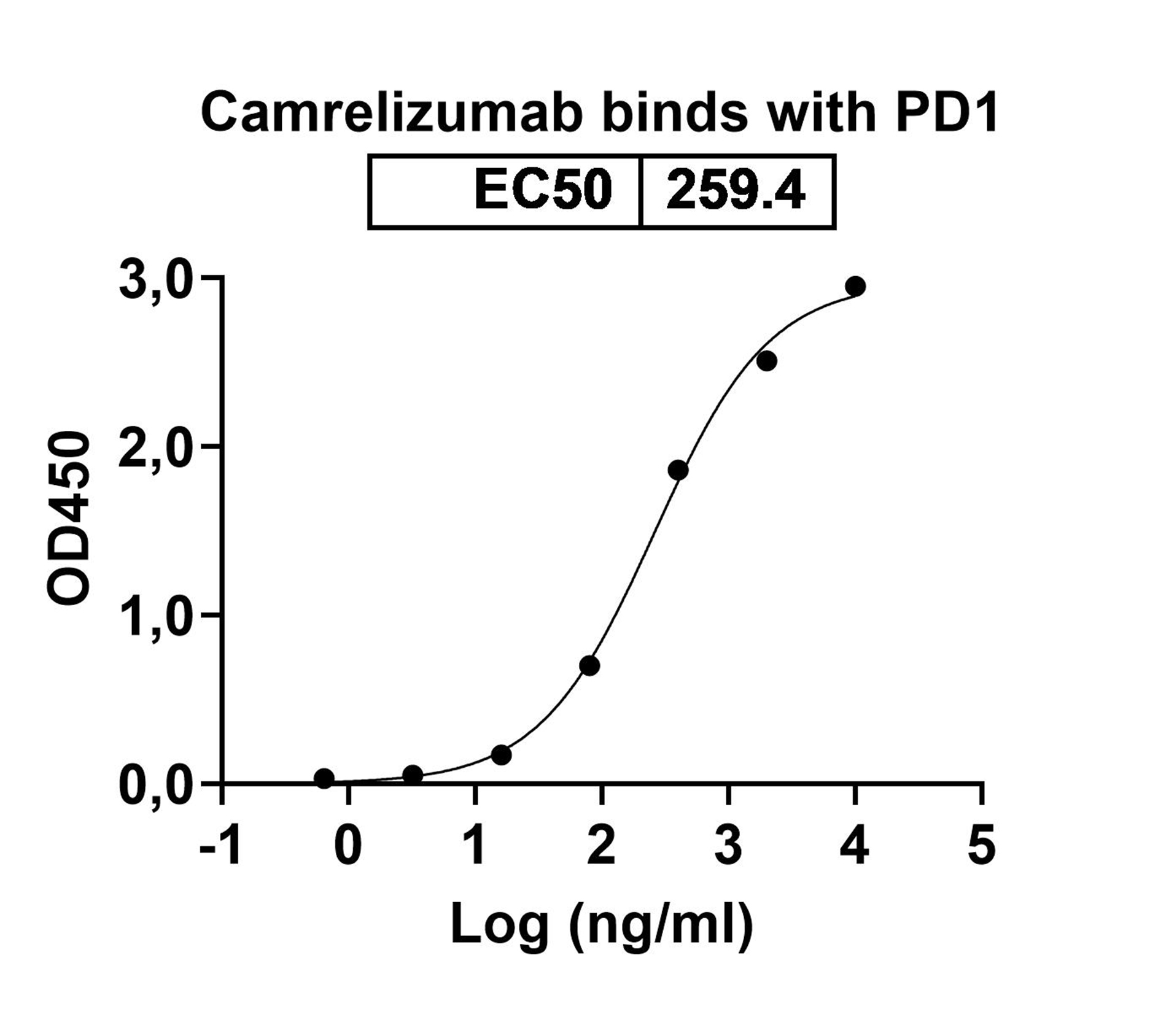 Bioactivity
Detects Human CD279/PDCD1/PD1 in indirect ELISAs.
-
 SDS-PAGE
SDS-PAGE for Research Grade Camrelizumab.