
Human NR3C1 Recombinant Protein (N-His)
- Catalog number: PH10532
- Availability: In Stock
$211.00
- Ex Tax: $211.00
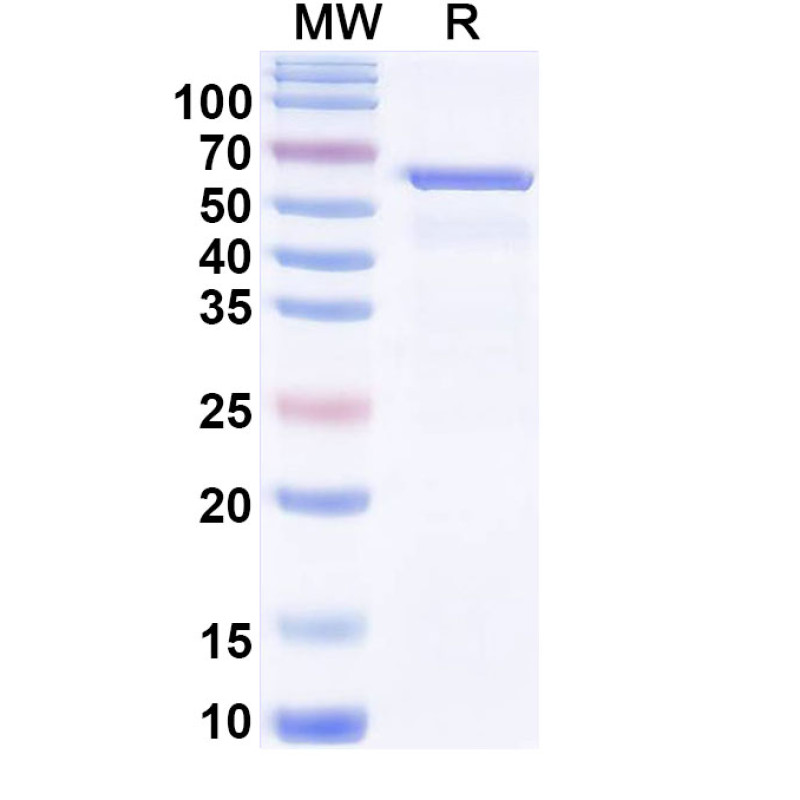
- Description: Recombinant Human NR3C1 Protein, N-His (PH10532) expressed in E. coli, spanning Val271-Lys777. Purity: >90% by SDS-PAGE.
Highlights:
• His-Tagged — N-terminal 6×His tag for IMAC purification.
• E. coli Expression — High-yield, cost-effective production.
• High Purity — >90% purity verified by SDS-PAGE. - Form: Lyophilized
- Storage buffer: Lyophilized from a solution in PBS pH 7.4, 0.02% NLS, 1mM EDTA, 4% Trehalose, 1% Mannitol.
- Purity: >90% as determined by SDS-PAGE.
- Applications: ELISA, Immunogen, SDS-PAGE, WB, Bioactivity testing in progress
- Endotoxin level: Please contact with the lab for this information.
- Expression system: E. coli
- Protein length: Val271-Lys777
- Predicted molecular weight: 59.11 kDa
- Stability and Storage: Use a manual defrost freezer and avoid repeated freeze thaw cycles. Store at 2 to 8°C for frequent use. Store at -20 to -80°C for twelve months from the date of receipt.
- Reconstitution: Reconstitute in sterile water for a stock solution. A copy of datasheet will be provided with the products, please refer to it for details.
- Alternative Names: GR, NR3C1, Nuclear receptor subfamily 3 group C member 1, GRL, Glucocorticoid receptor
- Species: Homo sapiens (Human)
- Shipping: In general, proteins are provided as lyophilized powder/frozen liquid. They are shipped out with dry ice/blue ice unless customers require otherwise.
- Background: Glucocorticoid receptor (NR3C1) is a ~85 kDa protein. Receptor for glucocorticoids (GC). Has a dual mode of action: as a transcription factor that binds to glucocorticoid response elements (GRE), both for nuclear and mitochondrial DNA, and as a modulator of other transcription factors. Affects inflammatory responses, cellular proliferation and differentiation in target tissues. Involved in chromatin remodeling. Plays a role in rapid mRNA degradation by binding to the 5' UTR of target mRNAs and interacting with PNRC2 in a ligand-dependent manner which recruits the RNA helicase UPF1 and the mRNA-decapping enzyme DCP1A, leading to RNA decay.
References:
1. Vitellius, G. et al. (2016) Human mutation 37, 794-803. PMID: 2712039
2. Tsai, JM. et al. (2023) Molecular cell 83, 2753-2767.e10. PMID: 37478846
3. Fadda, A. et al. (2017) Scientific reports 7, 41598. PMID: 28139699
4. Fryer, CJ. et al. (1998) Nature 393, 88-91. PMID: 9590696
5. Cho, H. et al. (2015) Proceedings of the National Academy of Sciences of the United States of America 112, E1540-9. PMID: 25775514 - Note: For research use only.
Images
-
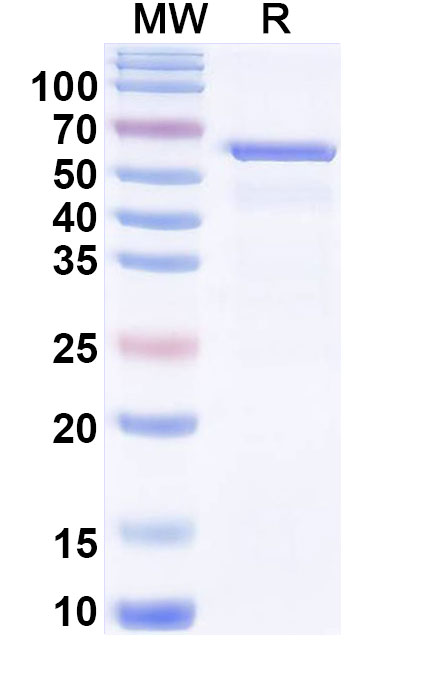 SDS-PAGE
SDS-PAGE for Recombinant Human NR3C1 Protein, N-His