


Anti-Human EphA3 Reference Antibody (Ifabotuzumab, RUO)
- Catalog number: BS10411
- Availability: In Stock
$176.00
- Ex Tax: $176.00
Description: Ifabotuzumab (BS10411) is a research-grade recombinant antibody targeting HEK. Produced in mammalian cells with native-like glycosylation.
Highlights:
• Research Grade — For PK/PD studies, assay development, and ADA research.
• Native Glycosylation — Mammalian expression ensures native-like patterns.
Host species: Humanized
Isotype: IgG1-kappa
Species reactivity: Human
Immunogen:
Form: Liquid
Storage instructions:
Storage buffer: 0.01M PBS, pH7.4.
Concentration: 0.92mg/ml
Purity: >95% as determined by SDS-PAGE.
Clonality: Monoclonal
Applications: Research Grade Biosimilar
Target: HEK,Eph-liketyrosinekinase1,EK4,EPHA3,Tyrosine-proteinkinasereceptorETK1,Tyrosine-proteinkinaseTYRO4,Ephrintype-Areceptor3,hEK4,ETK,TYRO4,ETK1,Humanembryokinase,EPH-likekinase4
Purification: Protein A/G purified from cell culture supernatant.
Endotoxin level: <1EU/mg, determined by LAL gel clotting assay
Expression system: Mammalian Cells
Stability and Storage: Use a manual defrost freezer and avoid repeated freeze-thaw cycles. Store at 4°C short term (1-2 weeks). Store at -20°C 12 months. Store at -80°C long term.
Alternative Names: Fibatuzumab,KB-004,CAS:1234137-51-9
Background: Ephrin type-A receptor 3 (EPHA3) is a ~110 kDa protein. Receptor tyrosine kinase which binds promiscuously membrane-bound ephrin family ligands residing on adjacent cells, leading to contact-dependent bidirectional signaling into neighboring cells. The signaling pathway downstream of the receptor is referred to as forward signaling while the signaling pathway downstream of the ephrin ligand is referred to as reverse signaling. Highly promiscuous for ephrin-A ligands it binds preferentially EFNA5. Upon activation by EFNA5 regulates cell-cell adhesion, cytoskeletal organization and cell migration. Also activated by EFNA1, inhibiting epithelial-to-mesenchymal transition of cardiac cells and playing a role in heart development.
References:
1. Lawrenson, ID. et al. (2002) Journal of cell science 115, 1059-72. PMID: 11870224
2. Sharfe, N. et al. (2003) Journal of immunology (Baltimore, Md. : 1950) 170, 6024-32. PMID: 12794130
Note: For research use only. Not suitable for clinical or therapeutic use.
Highlights:
• Research Grade — For PK/PD studies, assay development, and ADA research.
• Native Glycosylation — Mammalian expression ensures native-like patterns.
Host species: Humanized
Isotype: IgG1-kappa
Species reactivity: Human
Immunogen:
Form: Liquid
Storage instructions:
Storage buffer: 0.01M PBS, pH7.4.
Concentration: 0.92mg/ml
Purity: >95% as determined by SDS-PAGE.
Clonality: Monoclonal
Applications: Research Grade Biosimilar
Target: HEK,Eph-liketyrosinekinase1,EK4,EPHA3,Tyrosine-proteinkinasereceptorETK1,Tyrosine-proteinkinaseTYRO4,Ephrintype-Areceptor3,hEK4,ETK,TYRO4,ETK1,Humanembryokinase,EPH-likekinase4
Purification: Protein A/G purified from cell culture supernatant.
Endotoxin level: <1EU/mg, determined by LAL gel clotting assay
Expression system: Mammalian Cells
Stability and Storage: Use a manual defrost freezer and avoid repeated freeze-thaw cycles. Store at 4°C short term (1-2 weeks). Store at -20°C 12 months. Store at -80°C long term.
Alternative Names: Fibatuzumab,KB-004,CAS:1234137-51-9
Background: Ephrin type-A receptor 3 (EPHA3) is a ~110 kDa protein. Receptor tyrosine kinase which binds promiscuously membrane-bound ephrin family ligands residing on adjacent cells, leading to contact-dependent bidirectional signaling into neighboring cells. The signaling pathway downstream of the receptor is referred to as forward signaling while the signaling pathway downstream of the ephrin ligand is referred to as reverse signaling. Highly promiscuous for ephrin-A ligands it binds preferentially EFNA5. Upon activation by EFNA5 regulates cell-cell adhesion, cytoskeletal organization and cell migration. Also activated by EFNA1, inhibiting epithelial-to-mesenchymal transition of cardiac cells and playing a role in heart development.
References:
1. Lawrenson, ID. et al. (2002) Journal of cell science 115, 1059-72. PMID: 11870224
2. Sharfe, N. et al. (2003) Journal of immunology (Baltimore, Md. : 1950) 170, 6024-32. PMID: 12794130
Note: For research use only. Not suitable for clinical or therapeutic use.
Images
-
 SEC-HPLC
SEC-HPLC detection for Research Grade Ifabotuzumab.
-
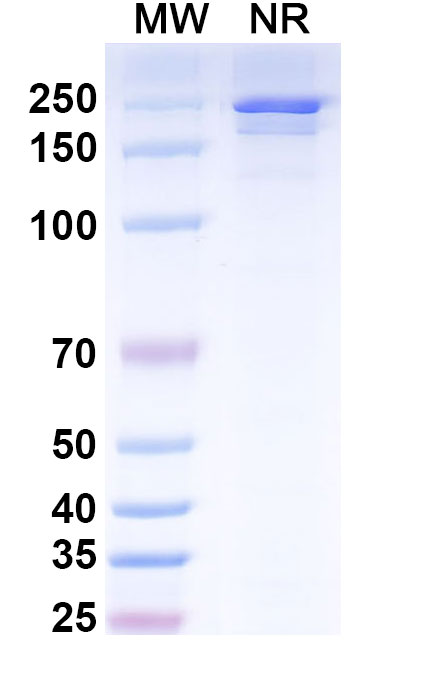 SDS-PAGE
SDS-PAGE for Research Grade Ifabotuzumab.
-
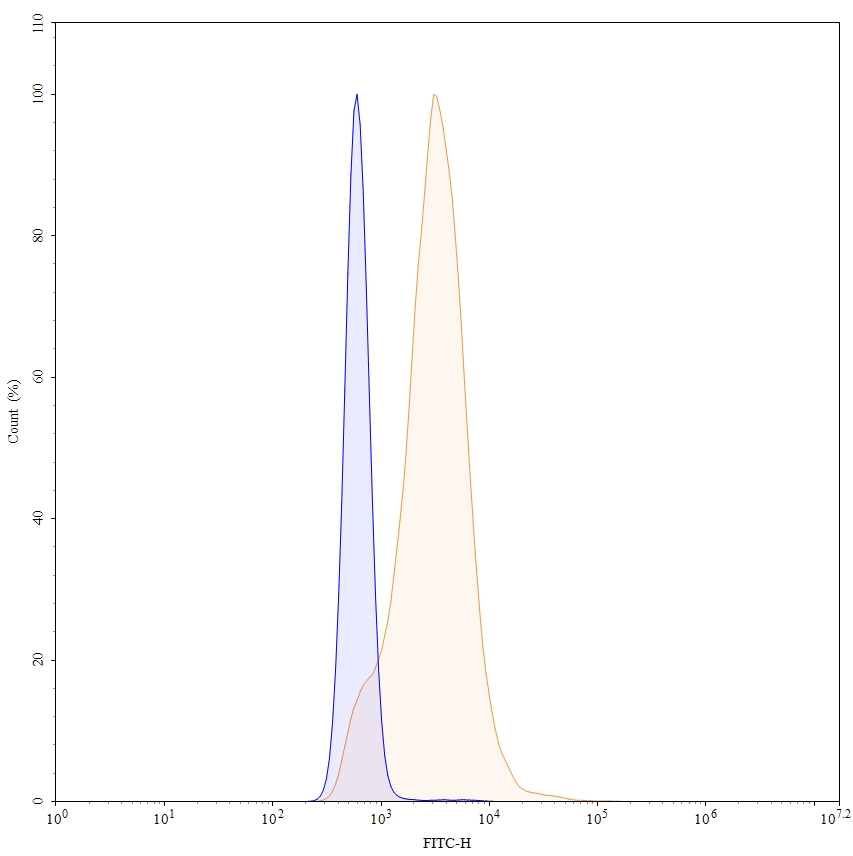 Flow Cytometry
Flow-cytometry using anti-human EPHA3 antibody. Jurkat cells were stained with an irrelevant antibody (Blue Histogram) or an anti-human EPHA3 monoclonal antibody (Catalog HB681016, Yellow Histogram) at a concentration of 5 µg/ml for 30 mins at RT. After washing, bound antibody was detected using a a Goat Anti-Human IgG H&L Polyclonal Antibody, FITC (abinScience: HF690414) and cells analysed on a NovoCyte Flow Cytometer.