
Human IL2 Recombinant Protein (C-His)
- Catalog number: PH15671
- Availability: In Stock
$211.00
- Ex Tax: $211.00
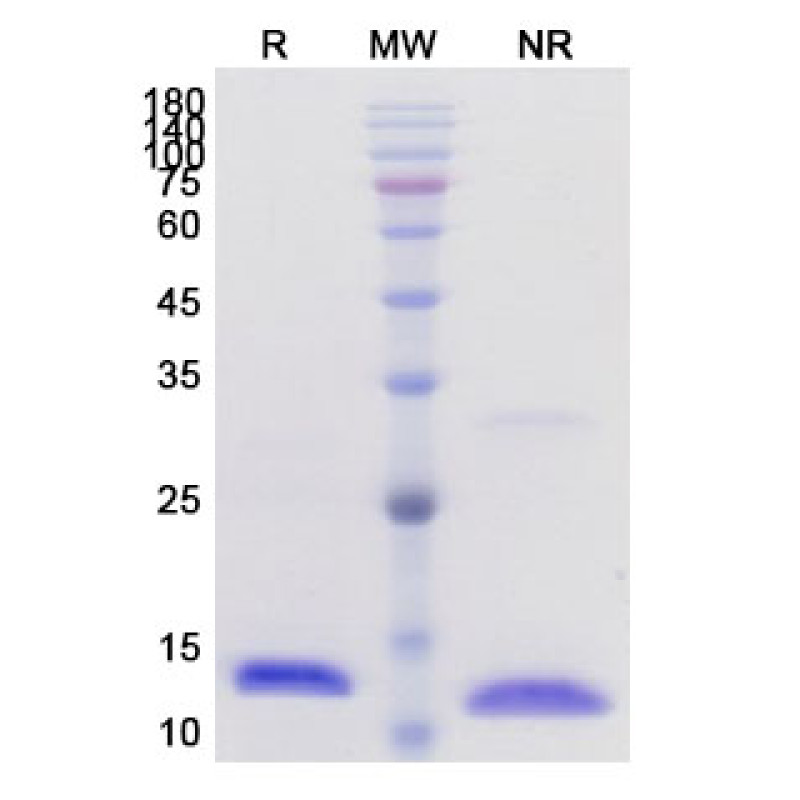
- Description: Recombinant Human IL2 Protein, C-His (PH15671) expressed in E. coli, spanning Met1-Thr134. Purity: >90% by SDS-PAGE.
Highlights:
• His-Tagged — N-terminal 6×His tag for IMAC purification.
• E. coli Expression — High-yield, cost-effective production.
• High Purity — >90% purity verified by SDS-PAGE. - Form: Lyophilized
- Storage buffer: Lyophilized from a solution in PBS pH 7.4, 0.02% NLS, 1mM EDTA, 4% Trehalose, 1% Mannitol.
- Purity: >90% as determined by SDS-PAGE.
- Applications: ELISA, Immunogen, SDS-PAGE, WB, Bioactivity testing in progress
- Endotoxin level: Please contact with the lab for this information.
- Expression system: E. coli
- Protein length: Met1-Thr134
- Predicted molecular weight: 16.48 kDa
- Stability and Storage: Use a manual defrost freezer and avoid repeated freeze thaw cycles. Store at 2 to 8°C for frequent use. Store at -20 to -80°C for twelve months from the date of receipt.
- Reconstitution: Reconstitute in sterile water for a stock solution. A copy of datasheet will be provided with the products, please refer to it for details.
- Alternative Names: IL2, IL-2, Aldesleukin, Interleukin-2, TCGF, T-cell growth factor
- Species: Homo sapiens (Human)
- Shipping: In general, proteins are provided as lyophilized powder/frozen liquid. They are shipped out with dry ice/blue ice unless customers require otherwise.
- Background: Interleukin-2 (IL2) is a ~17 kDa protein. Cytokine produced by activated CD4-positive helper T-cells and to a lesser extend activated CD8-positive T-cells and natural killer (NK) cells that plays pivotal roles in the immune response and tolerance. Binds to a receptor complex composed of either the high-affinity trimeric IL-2R (IL2RA/CD25, IL2RB/CD122 and IL2RG/CD132) or the low-affinity dimeric IL-2R (IL2RB and IL2RG). Interaction with the receptor leads to oligomerization and conformation changes in the IL-2R subunits resulting in downstream signaling starting with phosphorylation of JAK1 and JAK3. In turn, JAK1 and JAK3 phosphorylate the receptor to form a docking site leading to the phosphorylation of several substrates including STAT5. This process leads to activation of several pathways including STAT, phosphoinositide-3-kinase/PI3K and mitogen-activated protein kinase/MAPK pathways.
References:
1. Mingari, MC. et al. (1984) Nature 312, 641-3. PMID: 6438535
2. Wang, X. et al. (2005) Science (New York, N.Y.) 310, 1159-63. PMID: 16293754
3. Stauber, DJ. et al. (2006) Proceedings of the National Academy of Sciences of the United States of America 103, 2788-93. PMID: 16477002
4. Miyazaki, T. et al. (1994) Science (New York, N.Y.) 266, 1045-7. PMID: 7973659
5. Kirken, RA. et al. (1995) Cytokine 7, 689-700. PMID: 8580378
6. Osinalde, N. et al. (2015) Proteomics 15, 520-31. PMID: 25142963
7. Holbrook, NJ. et al. (1984) Proceedings of the National Academy of Sciences of the United States of America 81, 1634-8. PMID: 6608729 - Note: For research use only.
Images
-
 SDS-PAGE
SDS-PAGE for Recombinant Human IL2 Protein, C-His