

Human PDPN/Podoplanin Recombinant Protein (N-His-KSI)
- Catalog number: PH16318
- Availability: In Stock
$211.00
- Ex Tax: $211.00
- Description: Recombinant Human PDPN/Podoplanin Protein, N-His-KSI (PH16318) expressed in E. coli, spanning Ala23-Leu131. Purity: >90% by SDS-PAGE.
Highlights:
• His-Tagged — N-terminal 6×His tag for IMAC purification.
• E. coli Expression — High-yield, cost-effective production.
• High Purity — >90% purity verified by SDS-PAGE. - Form: Lyophilized
- Storage buffer: Lyophilized from a solution in PBS pH 7.4, 0.02% NLS, 1mM EDTA, 4% Trehalose, 1% Mannitol.
- Purity: >90% as determined by SDS-PAGE.
- Applications: ELISA, Immunogen, SDS-PAGE, WB, Bioactivity testing in progress
- Endotoxin level: Please contact with the lab for this information.
- Expression system: E. coli
- Protein length: Ala23-Leu131
- Predicted molecular weight: 26.89 kDa
- Stability and Storage: Use a manual defrost freezer and avoid repeated freeze thaw cycles. Store at 2 to 8°C for frequent use. Store at -20 to -80°C for twelve months from the date of receipt.
- Reconstitution: Reconstitute in sterile water for a stock solution. A copy of datasheet will be provided with the products, please refer to it for details.
- Alternative Names: Podoplanin, Aggrus, Glycoprotein 36, Gp36, PA2.26 antigen, T1-alpha, T1A, 29kDa cytosolic podoplanin intracellular domain, PICD, PDPN, GP36, PSEC0003, PSEC0025
- Species: Homo sapiens (Human)
- Shipping: In general, proteins are provided as lyophilized powder/frozen liquid. They are shipped out with dry ice/blue ice unless customers require otherwise.
- Background: Podoplanin (PDPN) is a ~16 kDa protein. Mediates effects on cell migration and adhesion through its different partners. During development plays a role in blood and lymphatic vessels separation by binding CLEC1B, triggering CLEC1B activation in platelets and leading to platelet activation and/or aggregation. Interaction with CD9, on the contrary, attenuates platelet aggregation induced by PDPN. Through MSN or EZR interaction promotes epithelial-mesenchymal transition (EMT) leading to ERZ phosphorylation and triggering RHOA activation leading to cell migration increase and invasiveness. Interaction with CD44 promotes directional cell migration in epithelial and tumor cells.
References:
1. Kato, Y. et al. (2003) The Journal of biological chemistry 278, 51599-605. PMID: 14522983
2. Kaneko, M. et al. (2004) The Journal of biological chemistry 279, 38838-43. PMID: 15231832
3. Kaneko, MK. et al. (2007) FEBS letters 581, 331-6. PMID: 17222411
4. Suzuki-Inoue, K. et al. (2007) The Journal of biological chemistry 282, 25993-6001. PMID: 17616532
5. Christou, CM. et al. (2008) The Biochemical journal 411, 133-40. PMID: 18215137
6. Nakazawa, Y. et al. (2008) Blood 112, 1730-9. PMID: 18541721
7. Martín-Villar, E. et al. (2006) Journal of cell science 119, 4541-53. PMID: 17046996
8. Fernández-Muñoz, B. et al. (2011) The international journal of biochemistry & cell biology 43, 886-96. PMID: 21376833
9. Martín-Villar, E. et al. (2010) Molecular biology of the cell 21, 4387-99. PMID: 20962267
10. Cueni, LN. et al. (2009) Experimental cell research 315, 1715-23. PMID: 19268462 - Note: For research use only.
Images
-
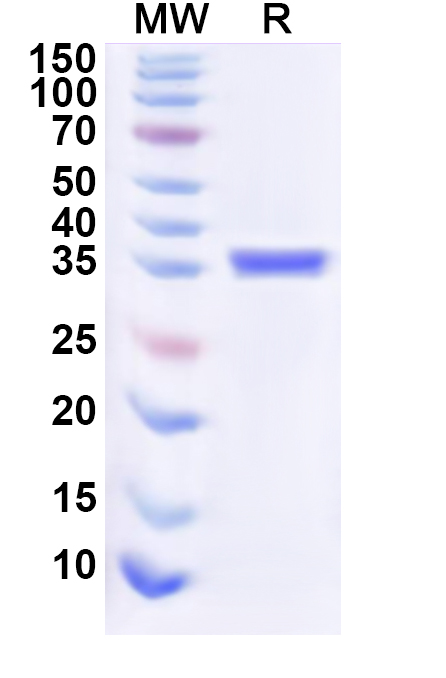 SDS-PAGE
SDS-PAGE for Recombinant Human PDPN/Podoplanin Protein, N-His-KSI