

Human OTUD4 Recombinant Protein (N-His)
- Catalog number: PH16517
- Availability: In Stock
$211.00
- Ex Tax: $211.00
- Description: Recombinant Human OTUD4 Protein, N-His (PH16517) expressed in E. coli, spanning Ala22-Val340. Purity: >90% by SDS-PAGE.
Highlights:
• His-Tagged — N-terminal 6×His tag for IMAC purification.
• E. coli Expression — High-yield, cost-effective production.
• High Purity — >90% purity verified by SDS-PAGE. - Form: Lyophilized
- Storage buffer: Lyophilized from a solution in PBS pH 7.4, 0.02% NLS, 1mM EDTA, 4% Trehalose, 1% Mannitol.
- Purity: >90% as determined by SDS-PAGE.
- Applications: ELISA, Immunogen, SDS-PAGE, WB, Bioactivity testing in progress
- Endotoxin level: Please contact with the lab for this information.
- Expression system: E. coli
- Protein length: Ala22-Val340
- Predicted molecular weight: 38.59 kDa
- Stability and Storage: Use a manual defrost freezer and avoid repeated freeze thaw cycles. Store at 2 to 8°C for one week. Store at -20 to -80°C for twelve months from the date of receipt.
- Reconstitution: Reconstitute in sterile water for a stock solution. A copy of datasheet will be provided with the products, please refer to it for details.
- Alternative Names: OTU domain-containing protein 4, HIN-1, HIV-1-induced protein HIN-1, OTUD4, KIAA1046
- Species: Homo sapiens (Human)
- Shipping: In general, proteins are provided as lyophilized powder/frozen liquid. They are shipped out with dry ice/blue ice unless customers require otherwise.
- Background: OTU domain-containing protein 4 (OTUD4) is a ~124 kDa protein. Deubiquitinase which hydrolyzes the isopeptide bond between the ubiquitin C-terminus and the lysine epsilon-amino group of the target protein. May negatively regulate inflammatory and pathogen recognition signaling in innate immune response. Upon phosphorylation at Ser-202 and Ser-204 residues, via IL-1 receptor and Toll-like receptor signaling pathway, specifically deubiquitinates 'Lys-63'-polyubiquitinated MYD88 adapter protein triggering down-regulation of NF-kappa-B-dependent transcription of inflammatory mediators. Independently of the catalytic activity, acts as a scaffold for alternative deubiquitinases to assemble specific deubiquitinase-substrate complexes. Associates with USP7 and USP9X deubiquitinases to stabilize alkylation repair enzyme ALKBH3, thereby promoting the repair of alkylated DNA lesions.
References:
1. Mevissen, TE. et al. (2013) Cell 154, 169-84. PMID: 23827681
2. Zhao, Y. et al. (2015) The EMBO journal 34, 1687-703. PMID: 25944111
3. Zhao, Y. et al. (2018) Molecular cell 69, 505-516.e5. PMID: 29395066 - Note: For research use only.
Images
-
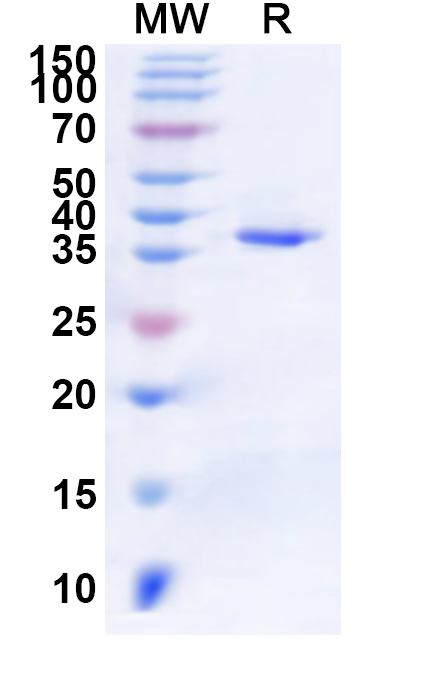 SDS-PAGE
SDS-PAGE for Recombinant Human OTUD4 Protein, N-His