

Anti-Human beta-NGF Reference Antibody (Tanezumab, RUO)
- Catalog number: BS10046
- Availability: In Stock
$176.00
- Ex Tax: $176.00
Description: Research Grade Tanezumab (BS10046) is a humanized monoclonal antibody detecting Beta-nerve growth factor in ELISA, Bioactivity: FACS, Functional assay, Research in vivo. Suitable for Human.
Highlights:
• Multi-Application — Validated across multiple applications.
Host species: Humanized
Isotype: IgG2-kappa
Species reactivity: Human
Immunogen:
Form: Liquid
Storage instructions:
Storage buffer: 0.01M PBS, pH7.4.
Concentration: 1.54mg/ml
Purity: >95% as determined by SDS-PAGE.
Clonality: Monoclonal
Applications: Research Grade Biosimilar
Target: Beta-nervegrowthfactor,NGFB,Beta-NGF,NGF
Purification: Protein A/G purified from cell culture supernatant.
Endotoxin level: <1EU/mg, determined by LAL gel clotting assay
Expression system: Mammalian Cells
Stability and Storage: Use a manual defrost freezer and avoid repeated freeze-thaw cycles. Store at 4°C short term (1-2 weeks). Store at -20°C 12 months. Store at -80°C long term.
Alternative Names: PF-04383119,RN624,CAS:880266-57-9
Background: Beta-nerve growth factor (Beta-nerve growth factor,NGFB,Beta-NGF,NGF) is a ~26 kDa protein. Nerve growth factor is important for the development and maintenance of the sympathetic and sensory nervous systems. Extracellular ligand for the NTRK1 and NGFR receptors, activates cellular signaling cascades to regulate neuronal proliferation, differentiation and survival (Probable). The immature NGF precursor (proNGF) functions as a ligand for the heterodimeric receptor formed by SORCS2 and NGFR, and activates cellular signaling cascades that lead to inactivation of RAC1 and/or RAC2, reorganization of the actin cytoskeleton and neuronal growth cone collapse. In contrast to mature NGF, the precursor form (proNGF) promotes neuronal apoptosis (in vitro). Inhibits metalloproteinase-dependent proteolysis of platelet glycoprotein VI.
References:
1. Einarsdottir, E. et al. (2004) Human molecular genetics 13, 799-805. PMID: 1497616
2. Carvalho, OP. et al. (2011) Journal of medical genetics 48, 131-5. PMID: 2097802
3. Wijeyewickrema, LC. et al. (2010) The Journal of biological chemistry 285, 11793-9. PMID: 20164177
Note: For research use only. Not suitable for clinical or therapeutic use.
Highlights:
• Multi-Application — Validated across multiple applications.
Host species: Humanized
Isotype: IgG2-kappa
Species reactivity: Human
Immunogen:
Form: Liquid
Storage instructions:
Storage buffer: 0.01M PBS, pH7.4.
Concentration: 1.54mg/ml
Purity: >95% as determined by SDS-PAGE.
Clonality: Monoclonal
Applications: Research Grade Biosimilar
Target: Beta-nervegrowthfactor,NGFB,Beta-NGF,NGF
Purification: Protein A/G purified from cell culture supernatant.
Endotoxin level: <1EU/mg, determined by LAL gel clotting assay
Expression system: Mammalian Cells
Stability and Storage: Use a manual defrost freezer and avoid repeated freeze-thaw cycles. Store at 4°C short term (1-2 weeks). Store at -20°C 12 months. Store at -80°C long term.
Alternative Names: PF-04383119,RN624,CAS:880266-57-9
Background: Beta-nerve growth factor (Beta-nerve growth factor,NGFB,Beta-NGF,NGF) is a ~26 kDa protein. Nerve growth factor is important for the development and maintenance of the sympathetic and sensory nervous systems. Extracellular ligand for the NTRK1 and NGFR receptors, activates cellular signaling cascades to regulate neuronal proliferation, differentiation and survival (Probable). The immature NGF precursor (proNGF) functions as a ligand for the heterodimeric receptor formed by SORCS2 and NGFR, and activates cellular signaling cascades that lead to inactivation of RAC1 and/or RAC2, reorganization of the actin cytoskeleton and neuronal growth cone collapse. In contrast to mature NGF, the precursor form (proNGF) promotes neuronal apoptosis (in vitro). Inhibits metalloproteinase-dependent proteolysis of platelet glycoprotein VI.
References:
1. Einarsdottir, E. et al. (2004) Human molecular genetics 13, 799-805. PMID: 1497616
2. Carvalho, OP. et al. (2011) Journal of medical genetics 48, 131-5. PMID: 2097802
3. Wijeyewickrema, LC. et al. (2010) The Journal of biological chemistry 285, 11793-9. PMID: 20164177
Note: For research use only. Not suitable for clinical or therapeutic use.
Images
-
 Bioactivity
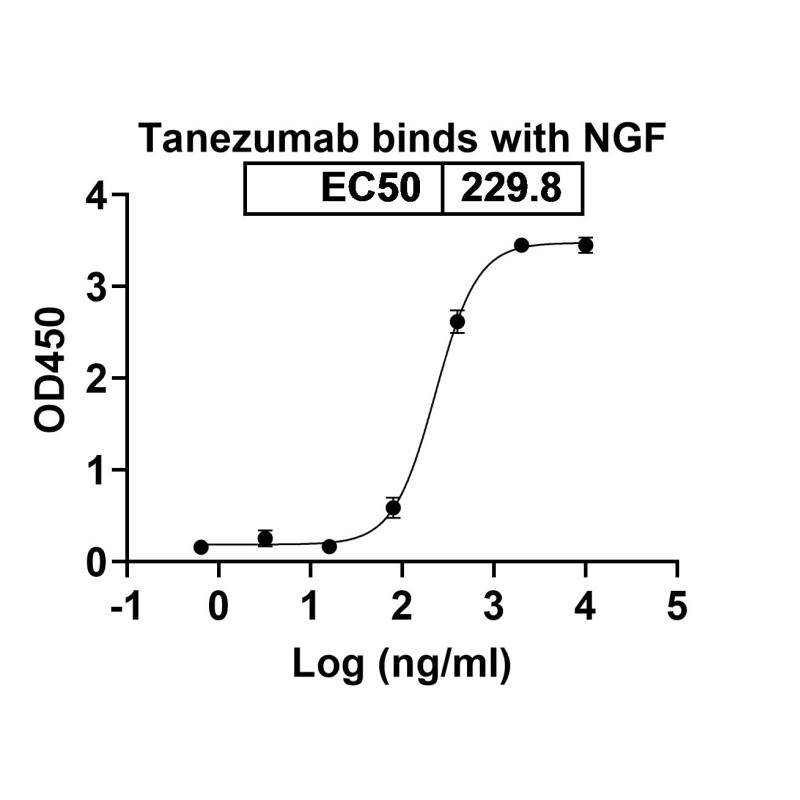
Detects Human NGF in indirect ELISAs.