
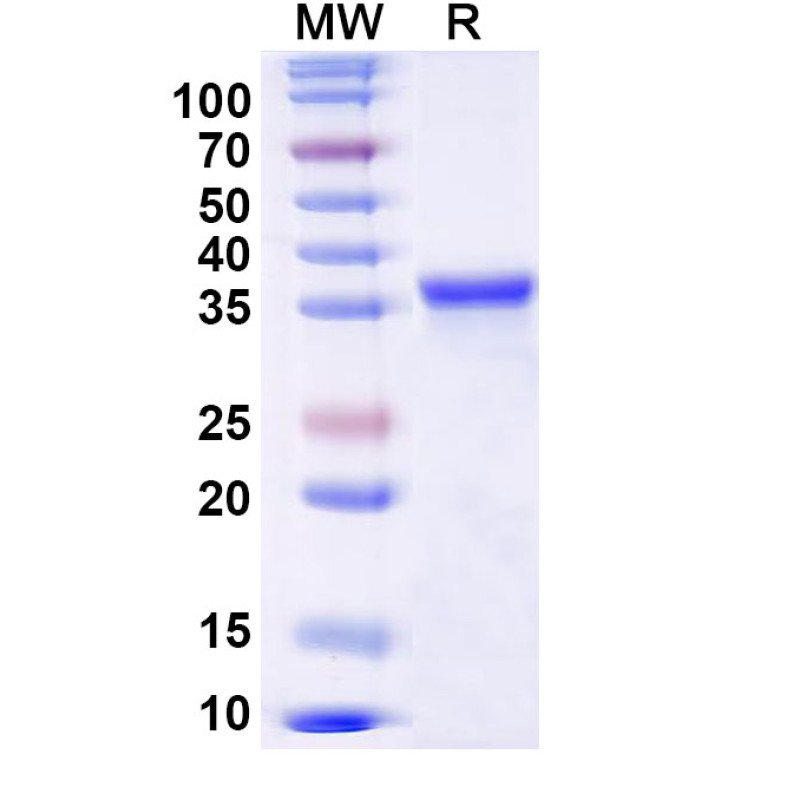
Mouse RIPK1 Recombinant Protein (N-His)
- Catalog number: PM10701
- Availability: In Stock
$211.00
- Ex Tax: $211.00
- Description: Recombinant Mouse RIPK1 Protein, N-His (PM10701) expressed in E. coli, spanning Met1-Pro310. Purity: >90% by SDS-PAGE.
Highlights:
• His-Tagged — N-terminal 6×His tag for IMAC purification.
• E. coli Expression — High-yield, cost-effective production.
• High Purity — >90% purity verified by SDS-PAGE. - Form: Lyophilized
- Storage buffer: Lyophilized from a solution in PBS pH 7.4, 0.02% NLS, 1mM EDTA, 4% Trehalose, 1% Mannitol.
- Purity: >90% as determined by SDS-PAGE.
- Applications: ELISA, Immunogen, SDS-PAGE, WB, Bioactivity testing in progress
- Endotoxin level: Please contact with the lab for this information.
- Expression system: E. coli
- Protein length: Met1-Pro310
- Predicted molecular weight: 37.79 kDa
- Stability and Storage: Use a manual defrost freezer and avoid repeated freeze thaw cycles. Store at 2 to 8°C for frequent use. Store at -20 to -80°C for twelve months from the date of receipt.
- Reconstitution: Reconstitute in sterile water for a stock solution. A copy of datasheet will be provided with the products, please refer to it for details.
- Alternative Names: Receptor-interacting serine/threonine-protein kinase 1, 2.7.11.1, Cell death protein RIP, Receptor-interacting protein 1, RIP-1, Ripk1, Rinp, Rip
- Species: Mus musculus (Mouse)
- Shipping: In general, proteins are provided as lyophilized powder/frozen liquid. They are shipped out with dry ice/blue ice unless customers require otherwise.
- Background: Receptor-interacting serine/threonine-protein kinase 1 (RIPK1) is a ~74 kDa protein. Serine-threonine kinase which is a key regulator of TNF-mediated apoptosis, necroptosis and inflammatory pathways. Exhibits kinase activity-dependent functions that regulate cell death and kinase-independent scaffold functions regulating inflammatory signaling and cell survival. Has kinase-independent scaffold functions: upon binding of TNF to TNFR1, RIPK1 is recruited to the TNF-R1 signaling complex (TNF-RSC also known as complex I) where it acts as a scaffold protein promoting cell survival, in part, by activating the canonical NF-kappa-B pathway. Kinase activity is essential to regulate necroptosis and apoptosis, two parallel forms of cell death: upon activation of its protein kinase activity, regulates assembly of two death-inducing complexes, namely complex IIa (RIPK1-FADD-CASP8), which drives apoptosis, and the complex IIb (RIPK1-RIPK3-MLKL), which drives necroptosis. RIPK1 is required to limit CASP8-dependent TNFR1-induced apoptosis.
References:
1. Newton, K. et al. (2014) Science (New York, N.Y.) 343, 1357-60. PMID: 24557836
2. Rickard, JA. et al. (2014) Cell 157, 1175-88. PMID: 24813849
3. Dillon, CP. et al. (2014) Cell 157, 1189-202. PMID: 2481385
4. Lin, J. et al. (2016) Nature 540, 124-128. PMID: 27819681
5. Geng, J. et al. (2017) Nature communications 8, 359. PMID: 2884257
6. Newton, K. et al. (2019) Nature 574, 428-431. PMID: 31511692
7. Tao, P. et al. (2020) Nature 577, 109-114. PMID: 3182728
8. Lalaoui, N. et al. (2020) Nature 577, 103-108. PMID: 31827281
9. Muendlein, HI. et al. (2021) Nature communications 12, 86. PMID: 33397971 - Note: For research use only.
Images
-
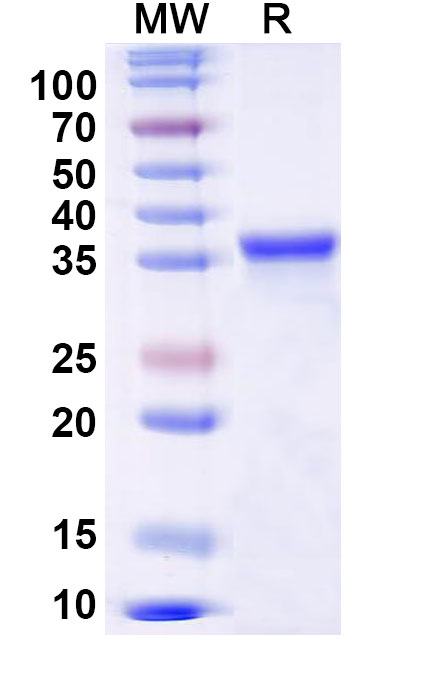 SDS-PAGE
SDS-PAGE for Recombinant Mouse RIPK1 Protein, N-His.